
Alibaba's Qwen Dominates Open Source AI, Overtakes Llama

A seismic shift in the open-source AI landscape has seen Chinese models capture 30% of global usage, a dramatic rise from just 1.2% in late 2024. This surge, led by models like Alibaba Cloud’s Qwen, is a direct response to a strategic pivot by major Western AI laboratories. As companies like OpenAI, Anthropic, and Google increasingly place their most powerful models behind restrictive, high-margin APIs, they have created an open-source vacuum that Chinese developers have decisively filled, establishing a new center of gravity in the global AI community.
This development signals a fundamental bifurcation in the philosophy and strategy of AI development worldwide. The latest data confirms how China’s AI ecosystem fills the open source vacuum with models engineered for accessibility and efficiency, creating what industry analysts now term “The Great AI Divide,” with significant implications for developers, businesses, and the trajectory of global innovation.
Key Points
- Chinese open-source models, led by Alibaba’s Qwen, now account for 30% of global AI model downloads and usage.
- This surge directly responds to Western AI labs’ strategic retreat from open source toward proprietary, API-gated ecosystems.
- Market adoption is driven by documented cost-efficiency and optimization for widely available hardware like Nvidia GPUs.
- Current market data confirms the establishment of two distinct global ecosystems: a closed Western agentic layer and a Chinese-led open-source foundation.
Walled Gardens and API Fortresses
The trend among major Western AI labs is a clear retreat from the open-sourcing of their most capable models. This strategic pivot is driven by commercial pressures and a competitive focus on building defensible moats around their technology. Instead of releasing model weights, these organizations provide access through paid APIs and build sophisticated ecosystems around their flagship products.
Anthropic’s recent releases exemplify this strategy. The company’s most advanced model, Claude Opus 4.6, is a premium offering for high-stakes enterprise tasks, available exclusively through paid tiers on platforms like Amazon Bedrock and Google’s Vertex AI. Pricing starts at $5 per million input tokens and $25 per million output tokens, prioritizing performance and control over open accessibility.

Beyond closing off models, these tech giants are also standardizing the infrastructure around their proprietary AI agents. OpenAI, Anthropic, and Google have backed the Model Context Protocol (MCP) through the Linux Foundation’s Agentic AI Foundation, as noted in a detailed industry analysis. While fostering interoperability, this move strategically reinforces the value of their closed models, shifting the competitive advantage to orchestration capabilities within a new, standardized ecosystem.
700 Million Downloads: China’s Digital Silk Road
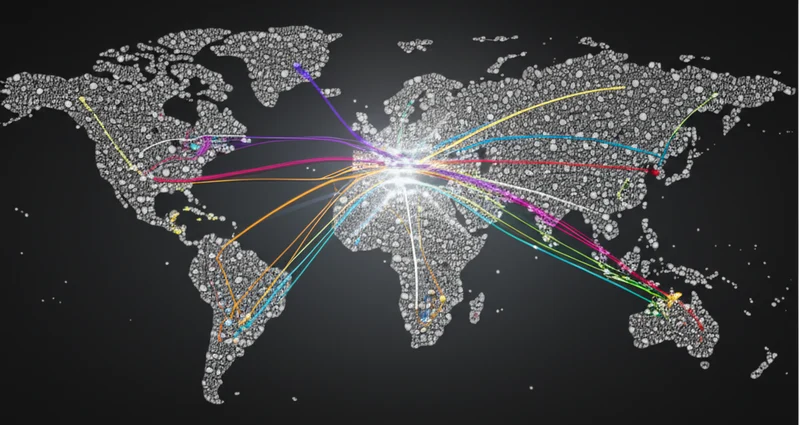
The vacuum left as Western AI labs retreat from open source has been filled with remarkable speed by Chinese developers. The most striking evidence comes from the meteoric rise of Qwen, an open-source model family from Alibaba Cloud. According to market analysis, Qwen surpassed Meta’s Llama in global downloads in October 2025, and the gap has continued to widen.
In a stunning display of market capture, Qwen’s downloads in December 2025 alone surpassed the next eight most popular models combined. This rapid adoption, which industry analyses like the SentinelOne Chinese AI report have explored, underscores a massive global demand for powerful, accessible AI that the Western proprietary model cannot satisfy. The download metrics demonstrate Chinese open-source AI models’ commanding position in today’s market landscape.

Accessible AI: The Pragmatic Revolution
The success of models like Qwen is not accidental; it is rooted in a deliberate strategy to meet the practical needs of developers and businesses. A key strategic advantage is the focus on running effectively on widely available hardware. In today’s market, this means optimizing for Nvidia GPUs, which hold over 80% of the market for AI training and deployment chips.
By ensuring their models can be run efficiently on the hardware companies and individuals already possess, Chinese developers are democratizing access to advanced AI. This is coupled with a focus on economic efficiency. These models offer competitive performance at a fraction of the cost, with pricing described as “cents per million tokens vs ChatGPT’s rates.” This low barrier to entry empowers a broader range of users to build and deploy AI solutions without prohibitive API costs.
Furthermore, developers are keenly focused on practical, in-demand features. For instance, Qwen’s multilinguality is cited as being “stronger than most alternatives,” a crucial feature for businesses serving diverse global customer bases. This focus on real-world utility accelerates adoption.
Silicon Kingdoms: Nvidia’s Cross-Border Reign
This strategic divergence is creating a bifurcated global AI landscape. The AI world is splitting into two parallel ecosystems: a Western proprietary ecosystem focused on high-margin, generalist AI agents orchestrated through protocols like MCP, and a global open-source ecosystem, increasingly led by Chinese models, that prioritizes accessibility, customization, and cost-efficiency.
While Western labs may lead in creating the most powerful “black box” models, the foundation for a vast array of customized, self-hosted, and specialized AI applications is being built on open-source alternatives. Underpinning both ecosystems is a shared dependency on high-performance computing hardware, primarily from Nvidia. As of 2025, Nvidia controlled 92% of the discrete GPU market, making the company a critical enabler of the global AI arms race, regardless of whether the models are open or closed.
The soaring demand from both Western and Eastern AI development has propelled Nvidia to a market capitalization exceeding $5 trillion, highlighting the foundational importance of the hardware layer in this new era of computing.
East Meets West: The New AI Equilibrium
The dominance of Chinese models in the open-source sphere is a direct and strategic response to the commercial pivot of Western AI giants. By delivering powerful, efficient, and accessible models tailored for the hardware and use cases of the broader developer community, they have successfully captured a vital and rapidly growing segment of the global AI market. This trend represents a fundamental and enduring split in the philosophy of AI development. As these two ecosystems continue to evolve along parallel tracks, the resulting technological diversity may ultimately drive innovation through complementary approaches to solving humanity’s most complex challenges.
Read More From AI Buzz

Vector DB Market Shifts: Qdrant, Chroma Challenge Milvus
The vector database market is splitting in two. On one side: enterprise-grade distributed systems built for billion-vector scale. On the other: developer-first tools designed so that spinning up semantic search is as easy as pip install. This month’s data makes clear which side developers are choosing — and the answer should concern anyone who bet […]

Anyscale Ray Adoption Trends Point to a New AI Standard
Ray just hit 49.1 million PyPI downloads in a single month — and it’s growing at 25.6% month-over-month. That’s not the headline. The headline is what that growth rate looks like next to the competition. According to data tracked on the AI-Buzz dashboard , Ray’s adoption velocity is more than double that of Weaviate (+11.4%) […]

Pydantic vs OpenAI Adoption: The Real AI Infrastructure
Pydantic, a data validation library most developers treat as background infrastructure, was downloaded over 614 million times from PyPI in the last 30 days — more than OpenAI, LangChain, and Hugging Face combined. That combined total sits at 507 million. The gap isn’t close. This single data point exposes one of the most persistent blind […]