
Vector DB Market Shifts: Qdrant, Chroma Challenge Milvus

The vector database market is splitting in two. On one side: enterprise-grade distributed systems built for billion-vector scale. On the other: developer-first tools designed so that spinning up semantic search is as easy as pip install. This month’s data makes clear which side developers are choosing — and the answer should concern anyone who bet on complexity as a moat.
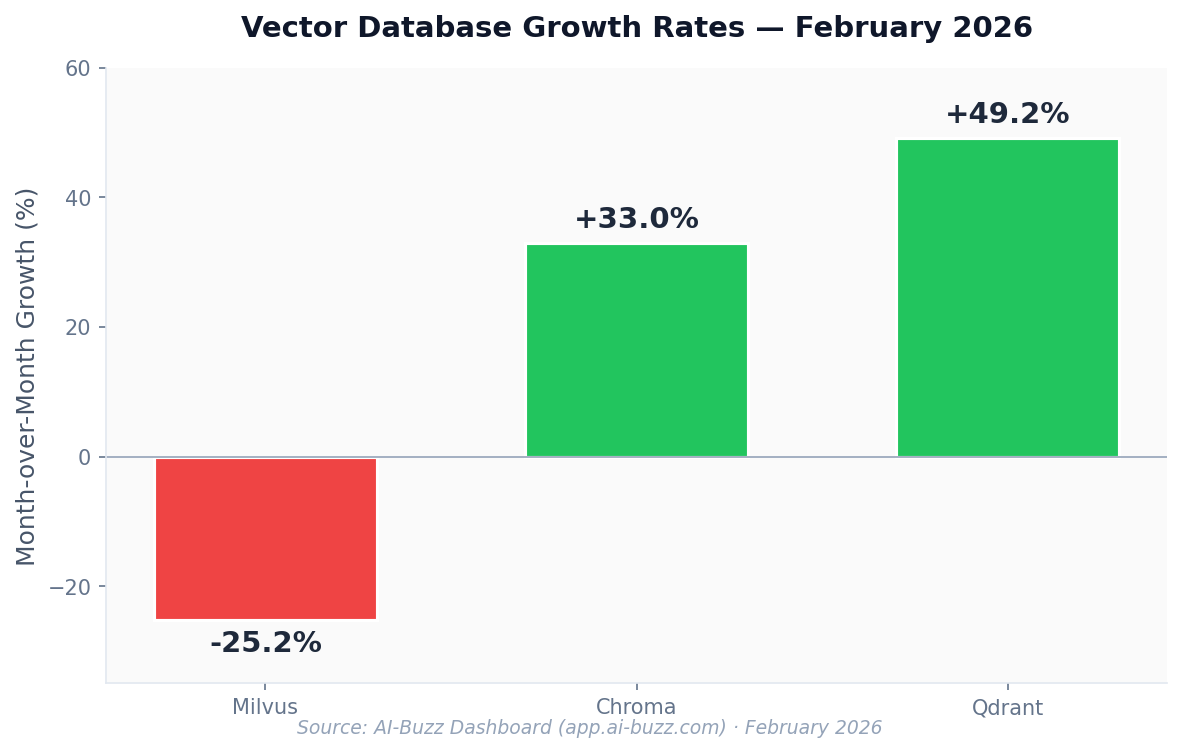
According to PyPI download data tracked by the AI-Buzz developer adoption dashboard, Milvus — the category leader by absolute install volume — saw its downloads fall 25.2% in a single month. In the same 30-day window, Qdrant grew 49.2% and Chroma grew 33.0%. That kind of simultaneous divergence is rare in mature open-source ecosystems. It suggests something structural is shifting, not just seasonal noise.
The Numbers
Milvus still leads in absolute volume. Its Python client pymilvus recorded 19.1 million downloads over the last 30 days — more than Qdrant and Chroma individually. But volume is a lagging indicator. Growth rate is the leading one.
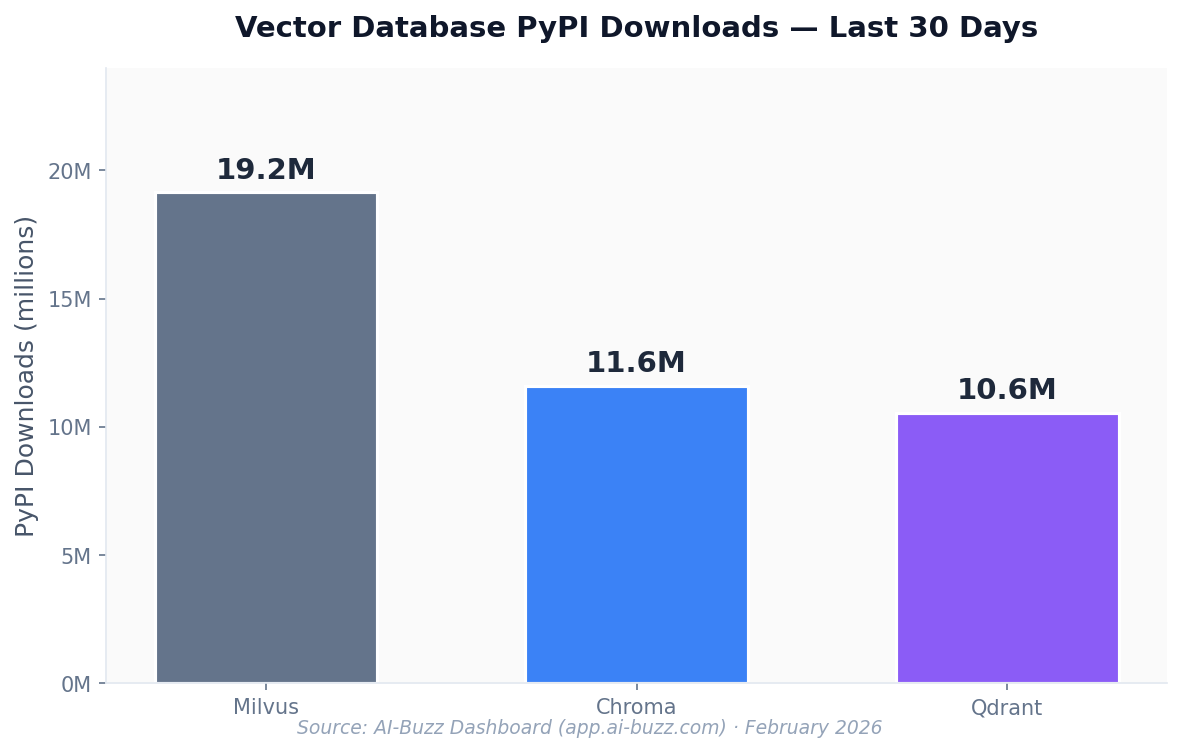
Chroma reached 11.6 million monthly downloads, growing 33% month-over-month. Qdrant hit 10.5 million, growing 49.2%. Both are also gaining traction beyond Python: Qdrant recorded 1.47 million npm downloads and Chroma 694,000 in the same window — a signal that both are becoming default choices in polyglot AI stacks, not just Python prototypes.
The full comparison data, updated daily, is available on the AI-Buzz head-to-head dashboard.
What’s Driving the Shift
Download trends don’t happen in a vacuum. Three forces explain why this divergence is occurring now.
1. Capital is funding the challengers
Qdrant closed a $28 million Series A led by Spark Capital in January 2024, following a $7.5 million seed round. That capital funded expanded engineering, developer relations, and enterprise GTM — the exact investments that compound into sustained download growth 12–18 months later. We’re now in that window.
Chroma raised $18 million in seed funding, enabling it to mature its hosted offering, expand its API surface, and cultivate the developer community that produces tutorials, integrations, and word-of-mouth referrals. Downloads follow community, and community follows investment in developer experience.
Milvus’s parent company Zilliz has raised significantly more ($113M total), but that capital has been directed primarily at enterprise sales and managed cloud infrastructure — not at reducing the friction of local development. The download data suggests the developer adoption flywheel is spinning faster for the teams investing in onboarding experience.
2. RAG moved from prototype to production
Retrieval-augmented generation went from a research curiosity to a standard production pattern in 2025. That transition changed what developers need from a vector database. During prototyping, you want the easiest possible setup. During production, you want something that scales without requiring a distributed systems team.
Chroma positioned itself perfectly for the prototyping wave: local-first, trivially embeddable, minimal configuration. Qdrant positioned for the production wave: high performance, production-grade filtering, on-disk indexing that scales without the operational complexity of a fully distributed system.
Milvus’s architecture — designed for organizations running billions of vectors with strict uptime requirements — is arguably overbuilt for the current median RAG use case. Its 3,841 GitHub forks reflect deep enterprise integration, but enterprise deployments have long switching cycles. The developers starting new projects today are the ones generating these download numbers.
3. The community conversation shifted
Over the last 30 days, Chroma and Qdrant each drew roughly 29 and 28 Hacker News mentions respectively — compared to just 8 for Milvus. That 3.5x gap in developer conversation matters because HN threads function as distributed technical reviews. When developers debate trade-offs and share benchmarks publicly, they influence the evaluation decisions of thousands of peers reading those threads.
Qdrant’s mindshare growth is particularly notable: its HN mentions grew 67% month-over-month, a rate that suggests the conversation is still accelerating. Track the full trend on Qdrant’s AI-Buzz profile.
The Enterprise Counterargument
Milvus is not in freefall. Context matters.
Zilliz was named “Highest Performer” in G2’s Summer 2025 Vector Database report. More than 10,000 enterprise teams use Milvus in production — including NVIDIA, Salesforce, eBay, Airbnb, and DoorDash. The project recently surpassed 40,000 GitHub stars, and its 100+ million total downloads reflect years of cumulative adoption that doesn’t disappear in a single quarter.
Enterprise customers don’t show up clearly in PyPI download stats — they run containerized deployments behind private registries, not pip install from the public index. A 25% download decline could partly reflect Milvus’s enterprise user base migrating to Zilliz Cloud (managed service), which wouldn’t be captured in open-source PyPI metrics.
This is not a death spiral. But it is a warning signal: when the developer adoption pipeline — the feeder system for future enterprise customers — contracts while competitors surge, the long-term implications are serious even if the enterprise installed base remains stable.
What the Data Doesn’t Show
Honest analysis requires acknowledging limits. PyPI download counts include CI/CD pipelines, automated builds, mirrored registries, and repeated installs that don’t map 1:1 to unique users. A single deployment pipeline running hundreds of times per day inflates a library’s count. These figures measure ubiquity, not active usage or satisfaction.
The growth rate is the more reliable signal, because it controls for this noise over time. A 25% single-month decline or a 49% single-month gain, sustained across millions of installs, is difficult to explain without genuine changes in the developer population.
We also can’t see why individual developers switched. The data shows the aggregate direction — it doesn’t tell us whether Milvus’s decline stems from new projects choosing alternatives, existing users migrating, or changes in CI/CD pipeline behavior. The community signals (HN mentions, GitHub activity) suggest real shifts in developer preference, but download telemetry alone can’t prove causation.
Full methodology details are available on the AI-Buzz methodology page.
What to Watch Next
The next 60–90 days will determine whether this is a correction or a trend.
If Milvus stabilizes above 15M monthly downloads and the decline proves to be a one-month anomaly — perhaps driven by a CI/CD change at a large user or a delayed enterprise release cycle — then the market is still a three-horse race with different segments: Milvus for enterprise scale, Qdrant for performance-sensitive production, Chroma for rapid prototyping.
If the divergence continues at current rates, Chroma overtakes Milvus in raw volume within 2–3 months. Qdrant follows shortly after. At that point, the narrative shifts from “challengers gaining ground” to “market has reorganized” — and the question becomes whether Milvus’s enterprise installed base is large enough to sustain a business independent of new developer adoption.
The deeper question: as generative AI applications mature from prototype to production, are developers prioritizing operational simplicity and developer experience over raw scalability? And if so, what does that mean for every other infrastructure category where enterprise-grade complexity once defined the market leader?
We’ll revisit this analysis in 30 days with updated data. Track the live comparison on AI-Buzz.
Data sourced from PyPI download telemetry, npm registry, and GitHub API, aggregated by the AI-Buzz developer adoption dashboard. All metrics updated daily. Methodology: downloads measured over rolling 30-day windows; growth rates calculated month-over-month. Full details on the methodology page.
Related Companies
Read More From AI Buzz

Perplexity pplx-embed: SOTA Open-Source Models for RAG
Perplexity AI has released pplx-embed, a new suite of state-of-the-art multilingual embedding models, making a significant contribution to the open-source community and revealing a key aspect of its corporate strategy. This Perplexity pplx-embed open source release, built on the Qwen3 architecture and distributed under a permissive MIT License, provides developers with a powerful new tool […]

New AI Agent Benchmark: LangGraph vs CrewAI for Production
A comprehensive new benchmark analysis of leading AI agent frameworks has crystallized a fundamental challenge for developers: choosing between the rapid development speed ideal for prototyping and the high-consistency output required for production. The data-driven study by Lukasz Grochal evaluates prominent tools like LangGraph, CrewAI, and Microsoft’s new Agent Framework, revealing stark tradeoffs in performance, […]

Anyscale Ray Adoption Trends Point to a New AI Standard
Ray just hit 49.1 million PyPI downloads in a single month — and it’s growing at 25.6% month-over-month. That’s not the headline. The headline is what that growth rate looks like next to the competition. According to data tracked on the AI-Buzz dashboard , Ray’s adoption velocity is more than double that of Weaviate (+11.4%) […]