
Amazon plans $100B AI spending spree

Despite all the buzz last week that DeepSeek might usher in an era of cheaper AI, potentially disrupting established players, there’s absolutely no indication that Big Tech is scaling back. Instead, they’re dramatically accelerating their investments, treating the potential for lower AI costs as a catalyst for increased demand, not a threat to revenue.
Amazon is the latest tech giant to unveil a colossal AI spending strategy, projecting well over $100 billion in capital expenditures for 2025. CEO Andy Jassy clarified during Amazon’s fourth-quarter earnings call that the “vast majority” of this $100 billion will be channeled towards bolstering AI capabilities within its cloud division, AWS, reflecting a significant Amazon AWS AI funding initiative. This aligns with the broader industry trend where Amazon, a ‘top pick’ of Wall Street, set to report with AI spending in focus.
(To be precise, Jassy indicated that Q4 2024’s capex spending of $26.3 billion “is reasonably representative” of the expected annualized spend in 2025. A simple calculation – multiplying that quarterly figure by four – yields a staggering $105.2 billion.)
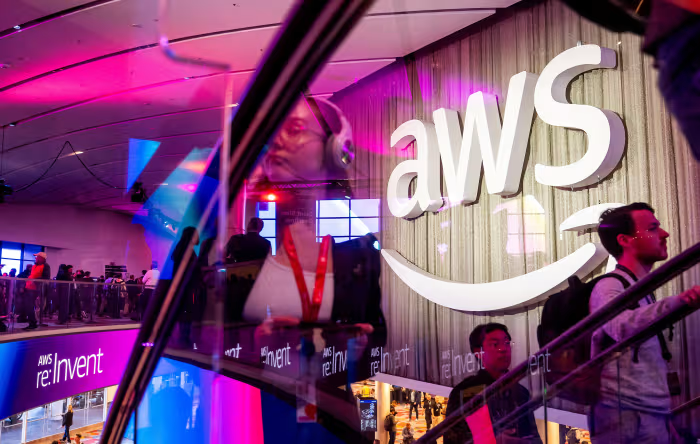
This represents a monumental leap from the $78 billion in capex that Amazon spent in 2024. It also highlights Amazon’s strategic investments, which include a massive $10 billion in Ohio and $11 billion in Georgia for data center expansion, critical for powering the computationally intensive demands of advanced AI, and potentially fueling future Amazon artificial intelligence research.
Amazon directly refuted concerns that cheaper AI would erode its revenue streams. Jassy posited that lower prices would, in fact, fuel greater demand for AI services. He argued that AWS, already brimming with a plethora of AI offerings, is exceptionally well-positioned to capitalize on this surge, particularly within AWS machine learning. “AI is the biggest change since the cloud and possibly the internet.” says Andy Jassy, Amazon’s CEO.
“Sometimes people make the assumption that if you’re able to decrease the cost of any type of technology component … that somehow it leads to less total spend in technology. We’ve never seen that to be the case,” Jassy stated, drawing parallels between the burgeoning AI demand and the transformative early stages of the internet and cloud computing. He further suggested that future development in AI technology, including areas like large language models (LLMs), would bring about even more personalized customer experiences.
This sentiment is echoed across the Big Tech landscape, with companies actively addressing investor anxieties about the substantial returns on their rapidly escalating AI research and development expenditures during this earnings season.
Meta CEO Mark Zuckerberg declared last week a long-term commitment to spending “hundreds of billions” on AI, emphasizing the escalating inference demands stemming from its billions of users. Meta is slated to invest at least $60 billion in capex in 2025, primarily directed towards AI infrastructure and development.
Simultaneously, Alphabet just boosted its 2025 capex by an impressive 42% to $75 billion. CEO Sundar Pichai rationalized this substantial spending increase by asserting that reduced AI costs “will make more use cases feasible,” leading to an overall expansion of the AI market. This competitive landscape is driving innovation, with analysts highlighting Amazon’s focus as crucial to maintaining its market share: Amazon’s AI investments are not just about improving efficiency but also about gaining a competitive edge in the e-commerce market.
And Microsoft announced last month a commitment to invest a whopping $80 billion in AI data centers in 2025 alone. This reflects the immense scale of resources being poured into the AI race.
Microsoft CEO Satya Nadella even directly referenced the economic principle of Jevons Paradox – the phenomenon where increased efficiency leads to increased consumption – by tweeting a link to the Wikipedia page for the concept, coinciding with the peak of the DeepSeek discussion.
The long-term validity of Jevons Paradox in the context of Big Tech’s AI infrastructure investments remains to be seen. However, the current reality is undeniable: there are no indications of a slowdown in AI spending; if anything, the trend points towards a significant acceleration.
Tags
Read More From AI Buzz

Vector DB Market Shifts: Qdrant, Chroma Challenge Milvus
The vector database market is splitting in two. On one side: enterprise-grade distributed systems built for billion-vector scale. On the other: developer-first tools designed so that spinning up semantic search is as easy as pip install. This month’s data makes clear which side developers are choosing — and the answer should concern anyone who bet […]

Anyscale Ray Adoption Trends Point to a New AI Standard
Ray just hit 49.1 million PyPI downloads in a single month — and it’s growing at 25.6% month-over-month. That’s not the headline. The headline is what that growth rate looks like next to the competition. According to data tracked on the AI-Buzz dashboard , Ray’s adoption velocity is more than double that of Weaviate (+11.4%) […]