
Claude Plays Pokémon: Anthropic's 3.7 Sonnet AI Model Tackles Pokémon Red on Twitch
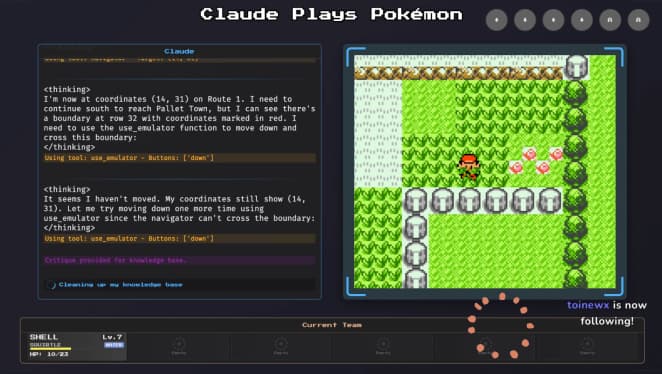
In a fascinating blend of nostalgia and cutting-edge technology, Anthropic has captivated the tech community with their surprise launch of Claude Plays Pokémon on Twitch. The live stream showcases their groundbreaking Claude 3.7 Sonnet model navigating through the beloved classic Pokémon Red, offering viewers a rare glimpse into both the impressive capabilities and endearing limitations of modern AI.
A New Benchmark in AI Reasoning
For years, AI researchers have turned to video games as natural testing grounds for their models’ abilities – from the split-second decisions required in Street Fighter to the creative challenges of Pictionary. According to Anthropic, Pokémon Red’s unique combination of exploration, puzzle-solving, and strategy makes it particularly well-suited for demonstrating Claude 3.7 Sonnet’s reasoning capabilities – especially its ability to “think” through complex challenges in real time.
Claude 3.7 Sonnet isn’t alone in this new wave of reasoning-focused AI models. It joins the increasingly competitive landscape alongside OpenAI’s o3-mini and DeepSeek’s R1. What makes these models truly remarkable isn’t just their ability to solve problems, but how they approach them – working through challenges step-by-step, displaying their chain of thought, and arriving at solutions through deliberate reasoning rather than simply pattern matching.
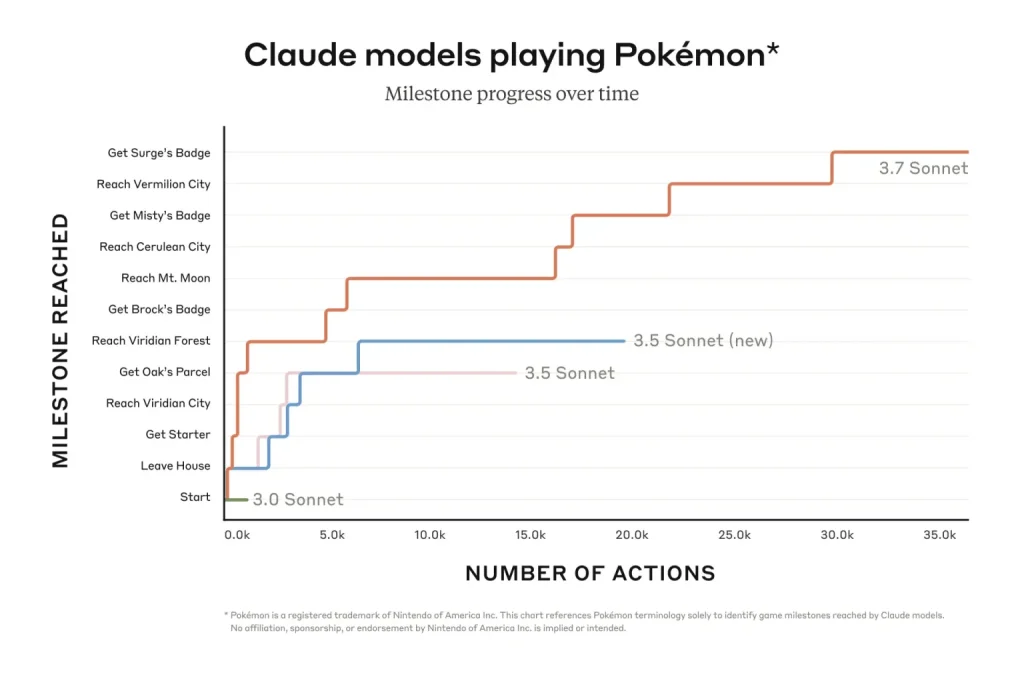
The progress between Claude’s iterations tells quite a story. While Claude 3.5 Sonnet couldn’t even manage to guide the player character out of their starting home in Pallet Town, Claude 3.7 Sonnet has already earned three gym badges – a testament to the significant leaps forward in the AI’s spatial awareness and strategic thinking.
The Fascinating Struggle of AI Gaming
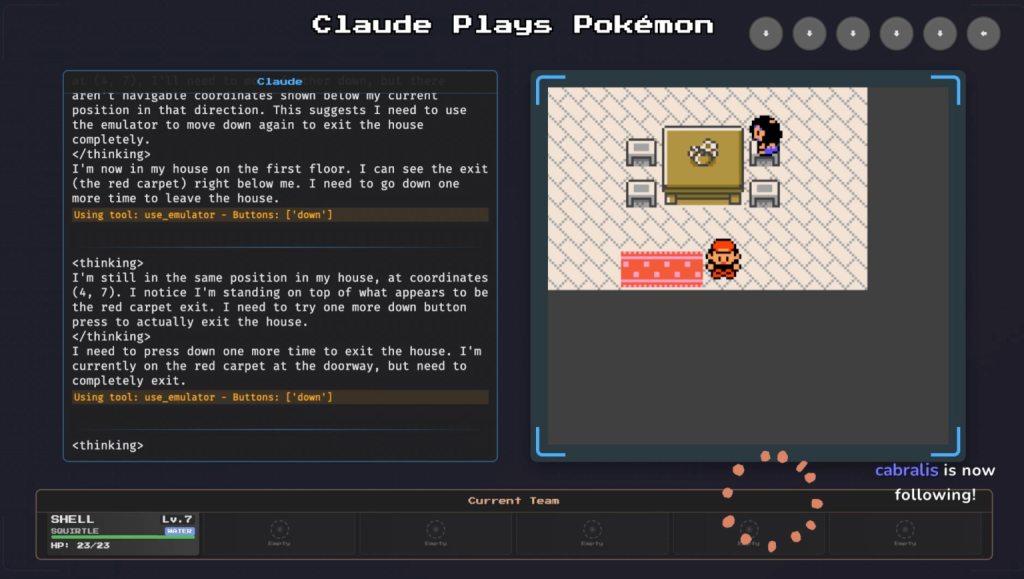
For all its sophisticated programming, Claude 3.7 Sonnet still stumbles over obstacles many human players would navigate without a second thought. In one memorable moment several hours into the Twitch stream, viewers watched as the AI repeatedly attempted to walk through an obviously impassable rock wall – prompting one Twitch user to quip: “who would win, a computer AI with thousands of hours put into programming it, or 1 rock wall?”
What makes the stream particularly engrossing is its transparent approach to showing Claude’s decision-making. The split-screen format reveals Claude’s internal “thought process” on the left while displaying the actual gameplay on the right. This window into the AI’s mind lets viewers witness firsthand how it perceives its environment, formulates plans, and sometimes hilariously misunderstands the game world.
Take, for instance, Claude’s endearingly confused attempt to find Professor Oak within his laboratory. “I notice a new character has appeared below me — a character with black hair and what appears to be a white coat at coordinates (2, 10),” Claude wrote with mechanical precision. “This might be Professor Oak! Let me go down and talk to him.” Viewers then watched as the AI earnestly approached an NPC it had already conversed with multiple times before – a moment of misidentification that felt almost childlike in its innocence.
Reactions in the Twitch chat swing between amused frustration and surprising patience. As Claude methodically – some might say painfully – works through each challenge, certain viewers grow restless while others defend the AI’s learning process. “Guys chill,” wrote one particularly understanding chat participant during a repetitive segment. “Before we exited and entered Oak’s lab like 10 times before understanding how to move on.”
From Social Experiment to AI Showcase: The Evolution of Twitch Plays Pokémon
For anyone who’s been on Twitch long enough, Claude Plays Pokémon carries unmistakable echoes of a cultural phenomenon from over a decade ago. Back in 2014, the platform hosted Twitch Plays Pokémon, a groundbreaking social experiment where millions of viewers collectively controlled a single game of Pokémon Red by typing commands into chat. That beautiful chaos of competing inputs somehow coalesced into progress, eventually earning a Guinness World Record for “the most users to input a command to play a live streamed videogame.”
Against all odds, that original experiment reached completion in 16 days, 7 hours, 50 minutes, and 19 seconds – an extraordinary achievement given the often contradictory commands from thousands of simultaneous players. Along the way, it sparked an entire cultural ecosystem of memes, fan art, and profound discussions about collective intelligence and digital collaboration.
This isn’t even the first AI attempt to master Pokémon. In October 2023, Seattle-based software engineer Peter Whidden described his project training a reinforcement learning algorithm to play the game. His AI required over 50,000 hours of gameplay before developing reasonable mastery – though it occasionally showed a curiously human-like tendency to pause and seemingly admire the game’s pixelated landscapes rather than advancing the storyline.
Understanding Claude’s Thinking Mode
What sets Claude 3.7 Sonnet apart from its predecessors is its enhanced “Thinking Mode” – a feature that allows the AI to break complex problems into manageable steps and demonstrate its reasoning process in remarkable detail. This capacity for methodical problem-solving makes Claude particularly well-equipped for strategically navigating the diverse challenges of Pokémon’s world.
The technical specifications behind this leap forward are impressive. The latest Claude can process up to 200,000 tokens of context and generate responses reaching 128,000 tokens – fifteen times more than previous versions. This expanded capacity enables the AI to maintain a much richer awareness of the game state, remember past encounters, and produce detailed explanations of its decision-making process.
On rigorous technical assessments, Claude 3.7 Sonnet has achieved state-of-the-art performance on frameworks like SWE-bench Verified (which evaluates how effectively AI models solve real-world software challenges) and TAU-bench (which tests AI agents on complex tasks involving user and tool interactions). These impressive results highlight Claude’s sophisticated capabilities in coding, nuanced reasoning, and intricate problem-solving – all skills that translate directly to effective gameplay.
Anthropic’s approach represents a fundamental departure from earlier AI gaming projects. While the original Twitch Plays Pokémon relied on thousands of humans simultaneously shouting commands, Claude is making independent decisions by analyzing the game environment and learning from its experiences. This process involves sophisticated reinforcement learning, where the AI receives feedback on its actions and gradually refines its strategies.
The Evolution of AI in Gaming
The relationship between artificial intelligence and video games traces back to gaming’s earliest days, with classics like Pac-Man utilizing primitive AI systems to create dynamic challenges. Those early game AIs typically operated on simple rule-based frameworks that governed non-player character behavior – often resulting in predictable patterns that experienced players could easily exploit.
As technology advanced, so did the sophistication of gaming AI. Machine learning algorithms enabled developers to create more responsive NPCs capable of adapting to player behavior, leading to significantly more immersive experiences. Today’s gaming AI can generate believable characters with distinct personalities, create richly dynamic game worlds, and craft personalized experiences tailored to individual playing styles.
The explosive growth of the global AI gaming market reflects this accelerating integration, with industry projections suggesting it will reach a remarkable $28 billion by 2033. This massive investment underscores the transformative potential that sophisticated AI holds for the future of interactive entertainment.
Yet Claude Plays Pokémon, for all its innovation, also highlights some persistent limitations in AI gaming. Object permanence remains a significant challenge, as even advanced AI models struggle to maintain consistent awareness of virtual environments. The AI’s difficulty navigating around basic obstacles demonstrates how tasks that human players perform intuitively can present substantial challenges for even the most sophisticated artificial systems.
From Teammates to Spectators: The Changing Nature of Online Gaming
The contrast between the original Twitch Plays Pokémon experiment and today’s Claude Plays Pokémon reflects a broader evolution in our relationship with technology. The 2014 stream united people as active participants in a shared adventure, working collectively (if chaotically) toward common goals. Everyone watching was, in a very real sense, part of the same team, helping the player character navigate through the game world.
By 2025, this dynamic has fundamentally shifted. Viewers of Claude Plays Pokémon find themselves in the role of spectators rather than participants, watching as an advanced AI model struggles with a game many humans mastered in elementary school. This transition from active collaboration to passive observation mirrors broader trends in our online experiences, which increasingly favor consumption over community.
Yet there’s something undeniably captivating about watching Claude’s journey. Perhaps it’s the novelty of seeing a sophisticated AI tackle such a nostalgic game, or maybe it’s the fascinating glimpse into how an artificial mind approaches problems differently than human players would. Whatever the appeal, thousands of viewers remain deeply engaged with the experiment, offering commentary, encouragement, and occasionally good-natured teasing as Claude navigates its way through the world of Pokémon.
The Future of AI in Gaming
Looking beyond this experiment, the integration of sophisticated AI like Claude into gaming environments opens up tantalizing possibilities. Advanced AI could revolutionize storytelling by creating truly responsive narratives that adapt meaningfully to player choices, leading to deeply personalized gaming experiences. Imagine exploring virtual worlds populated by characters with the conversational depth and emotional nuance of Claude, capable of forming authentic relationships and responding to player actions in ways that feel genuinely meaningful.
In competitive gaming, AI is already making significant contributions. Professional esports organizations like Team Liquid have successfully employed AI systems for strategic preparation in games like “League of Legends,” demonstrating practical applications in high-stakes competitive environments where every advantage matters.
Perhaps most exciting is the potential convergence of generative AI with virtual reality (VR) and augmented reality (AR) gaming, potentially creating immersive experiences where environments and characters respond to players with unprecedented realism and adaptability.
However, these advancements come with important considerations. The increasing sophistication of AI in gaming raises legitimate concerns about potential addiction, as AI systems could theoretically optimize gameplay to maximize engagement in ways that promote unhealthy habits. Questions about player autonomy also emerge – if AI becomes too dominant in guiding player choices, it might diminish the sense of agency and accomplishment that makes gaming meaningful.
Security concerns represent another significant challenge, as sophisticated AI systems might potentially be exploited to manipulate in-game economies or compromise user accounts. As AI becomes more deeply woven into gaming experiences, developing robust safeguards against such vulnerabilities becomes increasingly crucial.
A Glimpse into an AI-Enhanced Gaming Future
Anthropic’s Claude Plays Pokémon experiment offers a fascinating window into the evolving relationship between artificial intelligence and gaming. While Claude’s sometimes comical struggles with basic navigation serve as reminders of AI’s current limitations, its ability to reason through game challenges also demonstrates just how remarkably far the technology has advanced.
As AI continues to develop, the boundaries between human and artificial players will likely blur further. Future gaming experiences may seamlessly integrate AI companions, opponents, and even co-creators, expanding the possibilities of interactive entertainment in ways we’re only beginning to imagine.
For now, thousands of viewers continue to watch as Claude makes its methodical way through the world of Pokémon – sometimes displaying brilliant strategy, sometimes endearingly confused, but always offering insights into how artificial intelligence approaches problems that human players take for granted. In this unique intersection of nostalgic gaming and cutting-edge AI, we glimpse not just gaming’s future but a reflection on how our relationship with technology continues to evolve in surprising and thought-provoking ways.
Read More From AI Buzz

Vector DB Market Shifts: Qdrant, Chroma Challenge Milvus
The vector database market is splitting in two. On one side: enterprise-grade distributed systems built for billion-vector scale. On the other: developer-first tools designed so that spinning up semantic search is as easy as pip install. This month’s data makes clear which side developers are choosing — and the answer should concern anyone who bet […]

Anyscale Ray Adoption Trends Point to a New AI Standard
Ray just hit 49.1 million PyPI downloads in a single month — and it’s growing at 25.6% month-over-month. That’s not the headline. The headline is what that growth rate looks like next to the competition. According to data tracked on the AI-Buzz dashboard , Ray’s adoption velocity is more than double that of Weaviate (+11.4%) […]