
DeepCoder-14B: Open-Source AI Rivals Proprietary Giants
In a landscape where AI coding assistants have become essential developer tools, a powerful new contender has emerged: DeepCoder-14B-Preview. Developed through collaboration between Together AI and the Agentica research team (affiliated with Berkeley AI Research), this open-source model is making waves with its ability to match proprietary giants using just 14 billion parameters.
As the software development world increasingly embraces AI-powered productivity tools, developers face a choice between powerful but closed proprietary systems and the growing ecosystem of open-source alternatives. DeepCoder-14B represents a potential turning point in this landscape, offering performance that rivals OpenAI’s O3-Mini while maintaining complete transparency—from model weights and training data to reinforcement learning code and detailed logs.
Solving the Data Challenge in AI Code Generation
Creating powerful AI coding assistants has been notoriously difficult, largely due to a fundamental data problem. Unlike other AI domains, coding requires high-quality, verifiable data that can accurately assess whether generated solutions actually work. This verification challenge has historically limited progress in code-generating models.
The DeepCoder team tackled this obstacle by creating a specialized dataset of 24,000 verifiable coding problems specifically designed for reinforcement learning fine-tuning. Rather than relying on potentially unreliable web-scraped code, they carefully constructed a collection from trusted sources: the TACO Verified set, PrimeIntellect’s SYNTHETIC-1 dataset, and recent LiveCodeBench problems (from May 2023 to July 2024).
Their meticulous data preparation went beyond simple collection:
- Rigorous Testing: They verified each problem’s official solution against hidden test cases, ensuring all included problems were genuinely solvable.
- Comprehensive Validation: Every problem required at least five unit tests, significantly reducing the risk of “reward hacking” and encouraging the model to develop robust, generalizable solutions.
- Thorough Deduplication: They eliminated duplicates within and across datasets, while also ensuring no overlap with benchmark problems used for final evaluation.
This foundation of reliable, verifiable data was crucial for training a model capable of genuine code reasoning rather than superficial pattern matching.
The Technology Behind DeepCoder’s Performance
DeepCoder-14B’s impressive capabilities stem from a carefully engineered development process. The team began with the DeepSeek-R1-Distill-Qwen-14B foundation model, already recognized for its solid coding capabilities. This allowed them to focus specifically on enhancing complex code reasoning through advanced fine-tuning techniques.
The breakthrough came through an innovative reinforcement learning approach called GRPO+ (an enhanced version of Generalized Reward Policy Optimization). Key innovations included:
- Freedom to Explore: By removing certain constraints like entropy and KL divergence losses, they gave the model greater flexibility to discover optimal coding strategies while accelerating training.
- Specialized Techniques: “Overlong Filtering” and increased clipping bounds (“Clip High”) addressed challenges specific to code generation, helping the model learn long-range patterns while maintaining training stability.
- Massive Parallel Evaluation: A dual-sandbox setup—combining the scalable Together Code Interpreter with a local sandbox—enabled validation of over 1,000 coding problems during each RL step.
Training was resource-intensive, requiring 2.5 weeks on 32 H100 GPUs. The team employed a sparse Outcome Reward Model that only rewarded solutions passing all test cases, pushing the model toward complete correctness. Techniques like Iterative Context Lengthening gradually increased the context window during training to 32,000 tokens, ultimately enabling the model to handle up to 64,000 tokens at evaluation time.
Efficiency remained paramount throughout development. The team’s optimized training system, ‘verl-pipe’, reportedly doubled training speed compared to conventional methods. This system is now available in the open-sourced rLLM GitHub repository, providing a valuable resource for the broader AI community.
Impressive Benchmark Results Against Industry Leaders
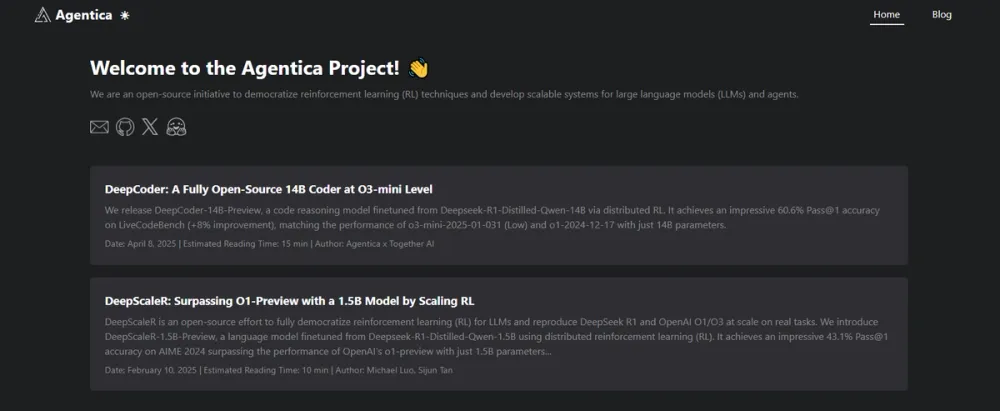
DeepCoder-14B’s performance speaks for itself. On the challenging LiveCodeBench (LCB), it achieved a remarkable 60.6% Pass@1 score (using problems from Aug 2024 – Feb 2025). This represents an 8% absolute improvement over its base model and puts it virtually on par with OpenAI’s proprietary O3-Mini (Low reasoning effort), which scored 60.9% on the same benchmark.
In competitive programming, DeepCoder-14B achieved a Codeforces rating of 1936, placing it in the 95.3 percentile among human competitors and rivaling O3-Mini’s 1918 rating. On the standard HumanEval+ benchmark for Python function generation, it scored an impressive 92.6% Pass@1, matching O3-Mini (Low) and slightly outperforming O1 (Low).
Unexpected Cross-Domain Excellence in Mathematics
Perhaps most surprising was DeepCoder-14B’s performance beyond coding tasks. It achieved a remarkable 73.8% accuracy on the AIME 2024 mathematics benchmark, significantly outperforming both its base model and O3-Mini (Low)’s 60.0% on this task. This suggests that training for robust code reasoning may inherently enhance broader logical abilities applicable to mathematical problem-solving.
This cross-domain transfer challenges conventional wisdom about AI specialization. Rather than requiring separate training for different reasoning tasks, the results indicate that fundamental cognitive capabilities may emerge from structured problem-solving training in any sufficiently complex domain.
The Future of Open-Source AI Coding
DeepCoder-14B represents a significant milestone for open-source AI coding. By matching or exceeding proprietary models with just 14 billion parameters while maintaining complete transparency, it demonstrates that cutting-edge code generation capabilities need not be locked behind closed systems.
For developers, this means powerful AI coding assistance that offers flexibility, customization options, and no vendor lock-in. For the AI research community, the fully open-sourced training methodology provides valuable insights and reproducible techniques for advancing the field.
As we look ahead, DeepCoder-14B opens exciting possibilities for further research into cross-domain reasoning capabilities and more efficient training methodologies. Its success suggests we may be entering a new era where sophisticated AI coding tools are both powerful and accessible—fundamentally transforming how software is created.
Read More From AI Buzz

Vector DB Market Shifts: Qdrant, Chroma Challenge Milvus
The vector database market is splitting in two. On one side: enterprise-grade distributed systems built for billion-vector scale. On the other: developer-first tools designed so that spinning up semantic search is as easy as pip install. This month’s data makes clear which side developers are choosing — and the answer should concern anyone who bet […]

Anyscale Ray Adoption Trends Point to a New AI Standard
Ray just hit 49.1 million PyPI downloads in a single month — and it’s growing at 25.6% month-over-month. That’s not the headline. The headline is what that growth rate looks like next to the competition. According to data tracked on the AI-Buzz dashboard , Ray’s adoption velocity is more than double that of Weaviate (+11.4%) […]