In a bold move that’s shaking up the AI chip industry, South Korean startup FuriosaAI has turned down an $800 million acquisition offer from Meta. This decision signals a high-stakes bet on the company’s technology and independent future in a market projected to reach nearly $1 trillion by 2034.
FuriosaAI, a South Korean startup specializing in AI chips, has rejected an $800 million acquisition offer from Meta, a move indicative of the FuriosaAI Meta acquisition rejection. The company is instead focusing on developing and producing its own AI chips, according to a local media report by Maeil Business Newspaper.
The deal, representing a potential Meta AI chip acquisition rejected, fell through due to disagreements over post-acquisition business strategy and organizational structure, rather than price, the report indicated.
This suggests that FuriosaAI prioritized its long-term vision over immediate financial gain.
“This is a classic example of a startup prioritizing its long-term vision over immediate financial gain,” said Dr. Anya Sharma, a semiconductor industry analyst at Tech Insights Group. “FuriosaAI clearly believes its independent path offers greater potential, even if it entails more risk.”
Why Meta Wanted FuriosaAI: Breaking Nvidia’s Stronghold
Meta, alongside other tech firms developing large language models (LLMs), seeks to lessen its dependence on Nvidia for specialized AI chips. The tech giant, which last year unveiled its own custom AI chips, stated in January that it would invest up to $65 billion this year in AI initiatives.
Neither FuriosaAI nor Meta responded immediately to requests for comment. This is common practice in such situations, often due to ongoing negotiations or internal discussions.
$48 Million Funding Round: FuriosaAI’s Next Strategic Move
FuriosaAI is reportedly in talks with investors to raise about $48 million (KRW 70 billion), according to Yonhap News Agency, and aims to complete the FuriosaAI funding round this month.
This indicates FuriosaAI’s continued need for capital to support its research, development, manufacturing, and expansion.
“Raising $48 million is a significant step, but it’s a drop in the bucket compared to the resources of a company like Meta,” commented David Chen, a venture capitalist specializing in AI startups. “This suggests FuriosaAI is confident in its ability to attract further investment and scale its operations organically.”
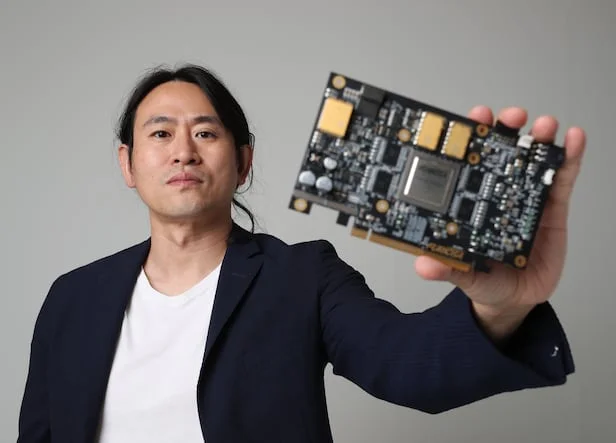
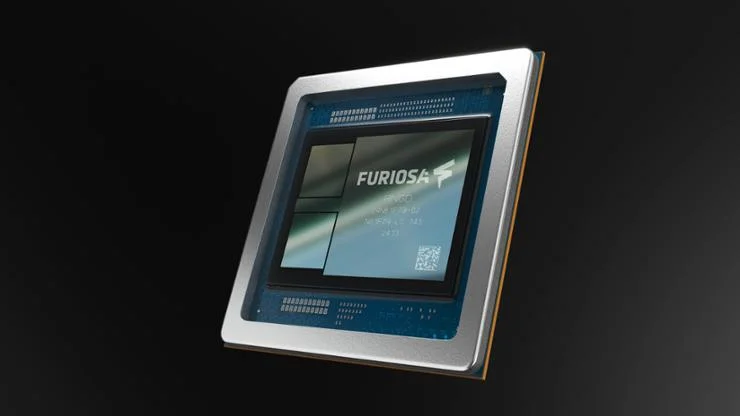
Founded in 2017 by June Paik, formerly of Samsung Electronics and AMD, FuriosaAI has developed two AI chips: Warboy and Renegade (RNGD). These chips are designed to compete with those from Nvidia and AMD.
Renegade: The Chip That Makes FuriosaAI Worth $800M
The startup reports completing tests of the RNGD chips, optimized for reasoning models, in partnership with LG AI Research and Aramco. LG AI Research plans to use RNGD chips in its AI infrastructure, and FuriosaAI aims to launch the FuriosaAI Renegade chip launch later this year, as reported by TMTPost.
“Reasoning models are at the heart of many advanced AI applications, from natural language processing to complex problem-solving,” explained Sarah Lee, a research scientist specializing in AI hardware. “If FuriosaAI can deliver on its promise of superior performance in this area, it could carve out a significant niche for itself.”
Beyond Money: Why FuriosaAI Rejected Meta’s Offer
Meta’s reported $800 million offer significantly exceeded FuriosaAI’s estimated valuation, highlighting Meta’s strong interest. However, negotiations broke down due to differences in strategy and organizational structure, not price.
“It’s not uncommon for acquisition talks to fall apart due to cultural clashes or disagreements about future direction,” said John Miller, a mergers and acquisitions lawyer. “Even if the financial terms are attractive, a startup’s founders may be reluctant to relinquish control if they believe it will compromise their long-term vision.”
The $927 Billion Question: Inside the Global AI Chip Race
The FuriosaAI-Meta situation reflects the intense global competition in the AI chip market. While Nvidia currently dominates, companies like Meta, Google, Amazon, and many startups are investing heavily in developing their own chips.
Reducing Reliance on Nvidia: Companies want to avoid the potential bottleneck and pricing power Nvidia holds.
Customization and Optimization: In-house chips can be tailored to specific AI workloads for better performance.
Strategic Control: Owning chip design and production provides control over the supply chain.
Cost Savings: Developing in-house chips can be more cost-effective in the long run.
The AI chip market is projected to grow significantly. Precedence Research projects a market size of $927.76 billion by 2034. This highlights the market’s potential and the fierce competition.
FuriosaAI’s Technology Edge: 3x Better Than Nvidia?
FuriosaAI’s core technology centers on its custom-designed AI chips, Warboy and Renegade. Key features include:
Energy Efficiency: FuriosaAI emphasizes the energy efficiency of its chips, especially Renegade.
Focus on Inference: The chips are primarily designed for inference, using trained models for predictions.
Partnerships with LG and Aramco: These partnerships provide access to real-world applications.
FuriosaAI claims the Renegade chip offers three times better performance per watt compared to Nvidia’s H100. If true, this would be a significant advantage in a market where energy efficiency directly impacts operating costs.
FuriosaAI’s Four Possible Futures
FuriosaAI’s future is uncertain, but rejecting Meta’s offer opens several possibilities:
Continued Independent Growth: FuriosaAI can continue raising capital and expanding independently.
Strategic Partnerships: Deeper collaborations with companies like LG and Aramco are possible.
Future Acquisition: Another company could acquire FuriosaAI in the future.
Initial Public Offering (IPO): FuriosaAI could pursue an IPO to raise capital publicly.
However, FuriosaAI also faces challenges:
Competition: The AI chip market is highly competitive, with established giants and startups.
Scaling Production: Manufacturing advanced chips is complex and capital-intensive.
Attracting and Retaining Talent: Competition for skilled engineers is fierce.
The $800 Million Gamble: Will David Beat Goliath?
FuriosaAI’s rejection of Meta’s acquisition offer represents one of the most daring bets in today’s tech landscape. The South Korean AI chip startup news highlights a fundamental question facing the industry: can specialized innovators outcompete tech giants with vastly greater resources?
For FuriosaAI, the answer is a resounding yes. Their decision signals extraordinary confidence not just in their technology, but in their ability to navigate the treacherous waters of capital-intensive chip manufacturing.
As the AI revolution continues to reshape our world, FuriosaAI’s bold stance may prove either prophetic or perilous. Either way, it serves as a powerful reminder that in technology, innovation sometimes requires refusing even the most golden of handcuffs.
The vector database market is splitting in two. On one side: enterprise-grade distributed systems built for billion-vector scale. On the other: developer-first tools designed so that spinning up semantic search is as easy as pip install. This month’s data makes clear which side developers are choosing — and the answer should concern anyone who bet […]
Ray just hit 49.1 million PyPI downloads in a single month — and it’s growing at 25.6% month-over-month. That’s not the headline. The headline is what that growth rate looks like next to the competition. According to data tracked on the AI-Buzz dashboard , Ray’s adoption velocity is more than double that of Weaviate (+11.4%) […]
Pydantic, a data validation library most developers treat as background infrastructure, was downloaded over 614 million times from PyPI in the last 30 days — more than OpenAI, LangChain, and Hugging Face combined. That combined total sits at 507 million. The gap isn’t close. This single data point exposes one of the most persistent blind […]