
Gemini 2.5 Pro Early Release Tops Web Dev Charts
Google has unexpectedly accelerated the release of Gemini 2.5 Pro “I/O Edition,” a model that’s already claimed the top spot on the influential WebDev Arena Leaderboard for its superior web application creation capabilities. The early launch showcases Gemini’s breakthrough ability to generate not just functional code, but aesthetically pleasing user interfaces — traditionally a major weakness for AI. For developers, this signals a shift in AI’s role from mere assistant to something closer to a senior collaborator.
Fast-Tracked Release Signals Competitive Strategy
Google typically saves its biggest AI announcements for the annual I/O developer conference, making this early release particularly noteworthy. While the company officially cites “overwhelming enthusiasm” from developers as the reason for the accelerated timeline, the move clearly serves as a strategic play in the increasingly competitive AI landscape.
“Google isn’t just showing off — they’re planting their flag in web development territory before competitors can catch up,” said Melissa Ramirez, AI analyst at TechFutures Research. “This early rollout gives them first-mover advantage in what could be one of the most impactful applications of AI for everyday developers.”
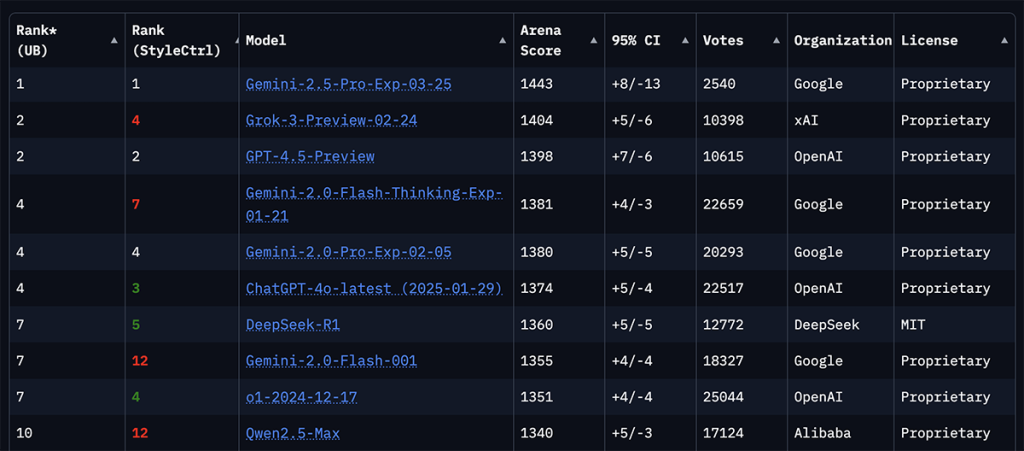
The “I/O Edition” specifically targets web and software development capabilities, with Google highlighting significant improvements in code generation, transformations, and creating complex interactive applications. Most notably, Gemini 2.5 Pro has secured the #1 position on the WebDev Arena Leaderboard, a benchmark that measures human preference for AI-generated web applications based on both aesthetics and functionality.
Beyond Code Completion: AI That Thinks Like a Senior Dev
What sets this release apart isn’t just incremental improvement but a qualitative leap in capabilities. Gemini 2.5 Pro surpassed its previous iteration by an impressive +147 Elo points on the WebDev Arena Leaderboard, signaling a major advancement in creating visually appealing interfaces — an area where AI has traditionally struggled.
The model’s technical prowess extends across multiple dimensions. It achieves a 75.6% score on LiveCodeBench v5 for code generation and 63.2% on SWE-bench Verified for agentic coding — metrics that translate to real-world capabilities in handling complex development challenges.
Early access users report that Gemini 2.5 Pro represents a significant evolution in AI coding assistance. Silas Alberti from Cognition noted that the model successfully solved a complex refactoring task involving request routing — not just by generating working code, but by demonstrating the kind of judgment typically associated with experienced human engineers.
A deeper analysis by Thoughtworks found the model capable of engaging in meaningful architectural discussions, with one tester observing that Gemini 2.5 Pro proactively raised thoughtful questions about scope and handling of device snapshots, showing “genuine architectural foresight” rather than simply responding to prompts.

“Vibe Coding” and the Democratization of Web Development
Perhaps the most revolutionary aspect of this release is the introduction of what Google calls “vibe coding” — the ability to generate complete, interactive web applications from high-level, conversational prompts. This capability dramatically lowers the barrier to entry for web development, potentially allowing non-coders to create functional prototypes.
Powering this feature is Gemini 2.5 Pro’s massive 1 million token context window (with plans to expand to 2 million), enabling the model to understand and process extensive codebases — reportedly between 30,000 and 50,000 lines of code — while maintaining a holistic understanding of system architecture.
Google has made these capabilities broadly accessible. The updated model is available through the Gemini API via Google AI Studio and Vertex AI, as well as within the Gemini application. Notably, existing users will automatically access the new version with no changes to pricing, minimizing friction for adoption.
The Business Impact: Beyond Developer Productivity
The impact of these advancements extends far beyond making developers’ lives easier. AI tools are already delivering measurable business outcomes, with reported productivity increases of 20-55% and cost savings of 30-50% for specific development tasks.
“What we’re seeing with Gemini 2.5 Pro is the evolution from AI as a coding assistant to AI as a full development partner,” explains tech industry analyst David Mercer. “This has profound implications for how companies allocate their engineering resources and approach digital product development.”
The model’s multimodal capabilities further expand its potential applications. With state-of-the-art video understanding (84.8% on the VideoMME benchmark), Gemini 2.5 Pro can transform video content into interactive applications. The ‘Video to Learning App’ tool in Google AI Studio demonstrates this by generating interactive learning experiences directly from YouTube videos.
The Future: AI-Augmented Development
As Gemini 2.5 Pro and competing models continue to advance, we’re witnessing the emergence of what might be called “AI-Augmented Lead Development” — a paradigm where human developers focus on high-level architecture, innovation, and oversight while AI handles increasingly complex implementation details.
This shift blurs traditional boundaries between coding, design, and content creation. Capabilities like “vibe coding” and generating applications from video inputs are making development more intuitive and accessible, potentially opening web creation to a much broader audience.
For established developers, the value proposition is clear: more time for creative problem-solving and less time spent on repetitive coding tasks. For businesses, it means faster iteration, lower development costs, and potentially more innovative digital products.
With Google I/O just around the corner, this early release of Gemini 2.5 Pro may be just the opening salvo in a new phase of the AI arms race — one that could fundamentally transform how we build for the web.
Tags
Read More From AI Buzz

Vector DB Market Shifts: Qdrant, Chroma Challenge Milvus
The vector database market is splitting in two. On one side: enterprise-grade distributed systems built for billion-vector scale. On the other: developer-first tools designed so that spinning up semantic search is as easy as pip install. This month’s data makes clear which side developers are choosing — and the answer should concern anyone who bet […]

Anyscale Ray Adoption Trends Point to a New AI Standard
Ray just hit 49.1 million PyPI downloads in a single month — and it’s growing at 25.6% month-over-month. That’s not the headline. The headline is what that growth rate looks like next to the competition. According to data tracked on the AI-Buzz dashboard , Ray’s adoption velocity is more than double that of Weaviate (+11.4%) […]