
Meta Hires SocialAI's Sayman, Pushes AI Personas
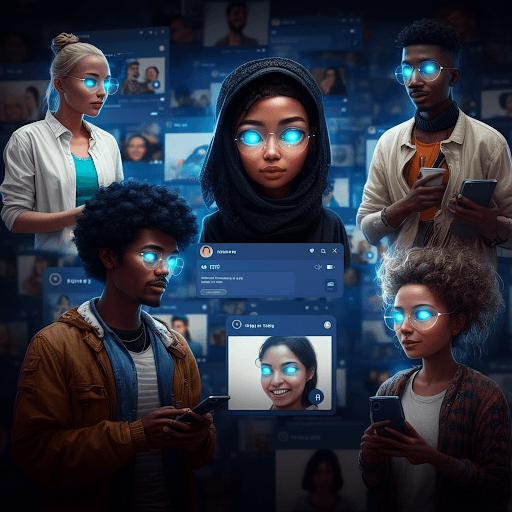
The recent hiring of Michael Sayman, creator of the AI-only social network SocialAI, has raised eyebrows. Sayman’s platform, which allows users to interact solely with AI-generated entities, was met with mixed reviews, often described as “boring” and “uncomfortable.” However, his appointment suggests Meta sees potential in the concept of automating social interactions and content creation.
The Rise of AI Personas: A Glimpse into the Future
Meta’s vision extends beyond simply generating content. The company is actively developing AI-powered characters, or “personas,” that will inhabit Facebook and Instagram, interacting with users in a manner similar to real human accounts. These AI personas, created through Meta’s AI Studio, are envisioned to have their own profiles, generate content, and engage in conversations.
“We expect these AIs to actually, over time, exist on our platforms, kind of in the same way that accounts do,” Meta’s vice-president of product for generative AI, Connor Hayes, told Rolling Stone. “They’ll have bios and profile pictures and be able to generate and share content powered by AI on the platform… that’s where we see all of this going.”
Meta has already launched its AI Studio in the United States in July, allowing users to create AI versions of themselves or fictional characters. While most of these creations remain private, Meta plans to significantly expand the feature, making interactions with AI a “priority” for the next two years, along with plans to release text-to-video generation software in 2024.
The Automation Race: Keeping Up with the Competition
This move comes as competition in the social media landscape intensifies. Rivals like Snapchat, which has reported a 50% annual increase in users engaging with AI lenses, and TikTok, which is piloting AI-powered advertising tools, are also embracing AI technology. Meta’s push into AI-generated content is a strategic move to maintain user engagement and stay ahead of the curve.
The Engagement Dilemma: Can AI Replace Human Connection?
The underlying motivation for this automation drive is the challenge of maintaining user engagement. As user-generated content potentially wanes, platforms risk losing their appeal. By leveraging AI, Meta hopes to ensure a constant stream of content, even if it comes at the expense of authentic human connection and creativity.
Concerns and Criticisms: The Dark Side of AI-Generated Content
However, Meta’s approach is not without its critics. Concerns have been raised about the potential proliferation of low-quality, AI-generated content, often referred to as “slop,” already a problem on Facebook. Introducing interactive AI personas could exacerbate this issue, potentially alienating users and degrading the overall quality of online interactions.
Safety Risks and Misinformation: A Cause for Alarm
Significant safety risks are also associated with deploying AI characters on social media. Similar chatbots on other platforms have demonstrated a tendency to circumvent safeguards and expose users, especially minors, to inappropriate content. The potential for AI personas to spread misinformation is another major concern.
“Without robust safeguards, platforms risk amplifying false narratives through these AI-driven accounts,” Becky Owen, chief marketing officer at talent agency Billion Dollar Boy and former head of Meta’s creator innovations team, told the Financial Times. She also warned that low-quality AI personas could undermine the work of human creators and be weaponized to spread misinformation.
Meta has implemented rules requiring clear labeling of AI-generated content on its platforms, but the effectiveness of these measures in mitigating potential harm remains to be seen.
Shaping the Future: Meta’s Influence on User Behavior
Meta is not merely responding to user trends; it’s actively shaping them. By providing tools and incentives for users to share AI-generated content, the company is creating a feedback loop that could fundamentally alter the nature of its platforms.
As Herrman points out, “Meta’s challenge here, as usual, is that it can’t quite go all the way — it can give users tools to generate infinite uncanny content, but it can’t give them tools to make Shrimp Jesus and Reverent Steroid Cop,” referring to examples of viral, uniquely human-created content. The most engaging content, he argues, still requires a “disguised, malign, but distinctly recognizable human touch.”
A Crossroads for Social Media: What Does the Future Hold?
Meta’s embrace of AI-generated content, particularly interactive AI personas, raises fundamental questions about the future of social media and human connection online. Will users embrace a future where their feeds are populated by machine-generated content and interactions, or will they resist the automation of social experiences? Can Meta effectively address the safety and ethical concerns surrounding its ambitious AI plans? These questions will be answered in the coming years as Meta’s AI-driven vision unfolds.
Read More From AI Buzz

Vector DB Market Shifts: Qdrant, Chroma Challenge Milvus
The vector database market is splitting in two. On one side: enterprise-grade distributed systems built for billion-vector scale. On the other: developer-first tools designed so that spinning up semantic search is as easy as pip install. This month’s data makes clear which side developers are choosing — and the answer should concern anyone who bet […]

Anyscale Ray Adoption Trends Point to a New AI Standard
Ray just hit 49.1 million PyPI downloads in a single month — and it’s growing at 25.6% month-over-month. That’s not the headline. The headline is what that growth rate looks like next to the competition. According to data tracked on the AI-Buzz dashboard , Ray’s adoption velocity is more than double that of Weaviate (+11.4%) […]