Perplexity AI Launches Free "Deep Research" Tool, Challenging OpenAI and Google
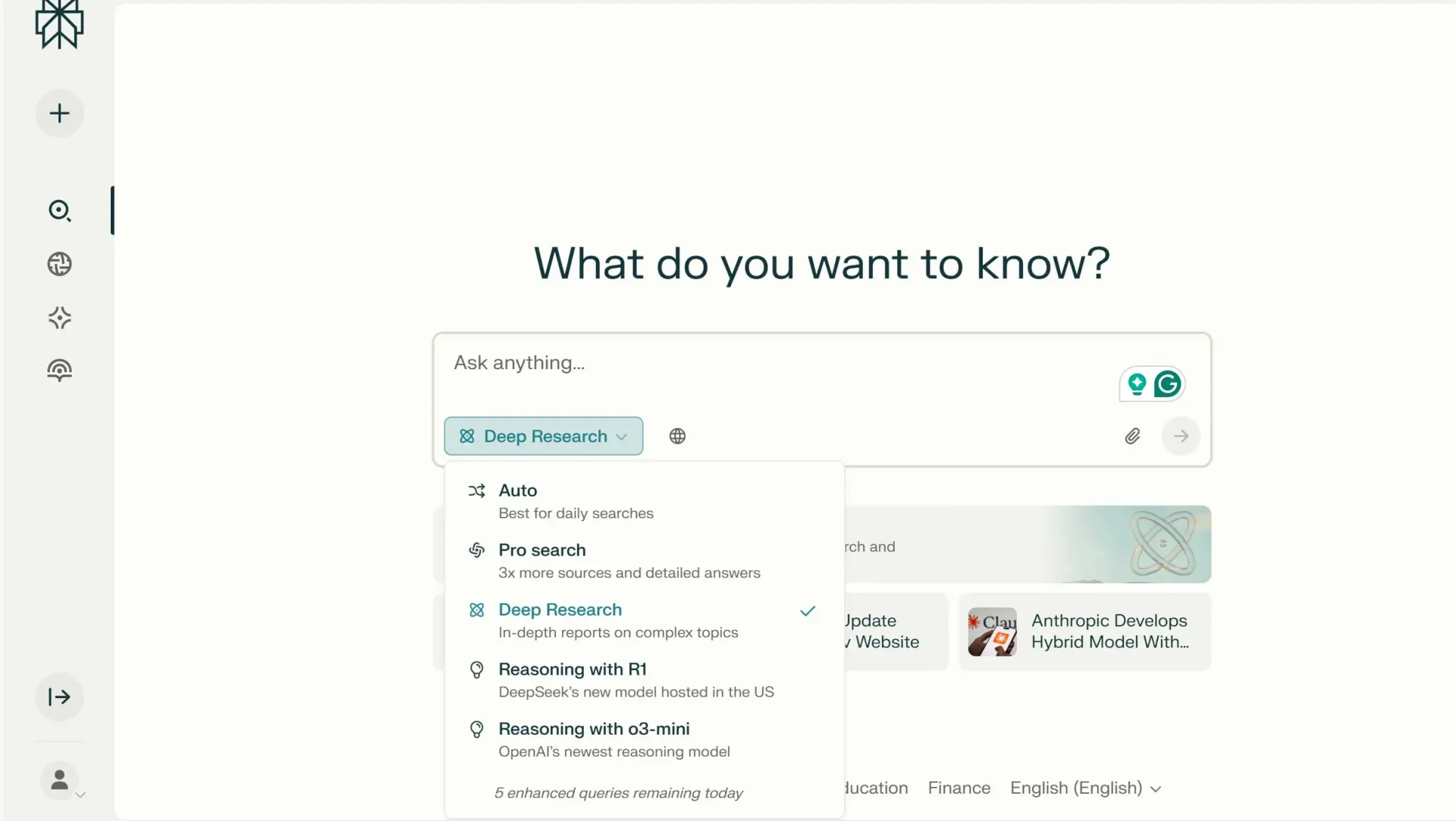
Perplexity has entered the competitive AI-powered research arena with its new “Deep Research” feature, announced on Friday. This launch directly challenges similar offerings from Google and OpenAI, intensifying the race to transform how information is accessed and synthesized. The new Perplexity Deep Research tool is free to use.
Google unveiled a similar feature for its Gemini AI platform in December. OpenAI then launched its own research agent earlier this month. All three companies have converged on the same name: “Deep Research,” signaling a shared vision for the future. Those looking for an AI deep research tools comparison will find many similarities.
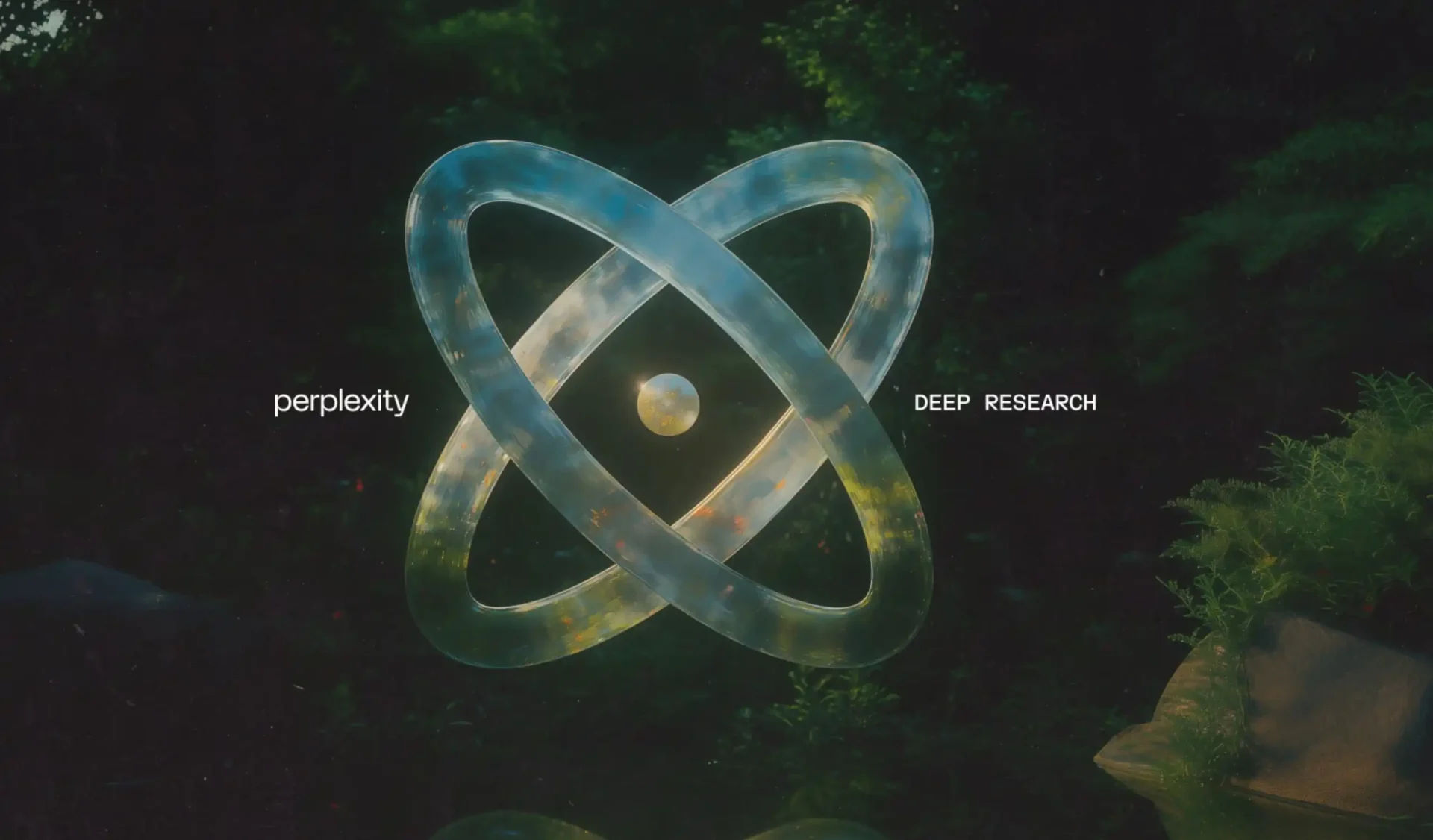
Perplexity AI’s Deep Research interface provides users with a clean and intuitive way to conduct in-depth research.
The core objective is to move beyond consumer chatbots, offering professionals more comprehensive answers and verifiable citations. In a blog post announcing Deep Research, Perplexity stated the feature “excels at a range of expert-level tasks—from finance and marketing to product research.” The tool could be described as using AI for in-depth research reports.
Perplexity’s Deep Research is immediately available on the web and will soon be integrated into its Mac, iOS, and Android apps. Users can access it via a drop-down menu when submitting a query, generating a detailed report exportable as a PDF or shared as a “Perplexity Page.”
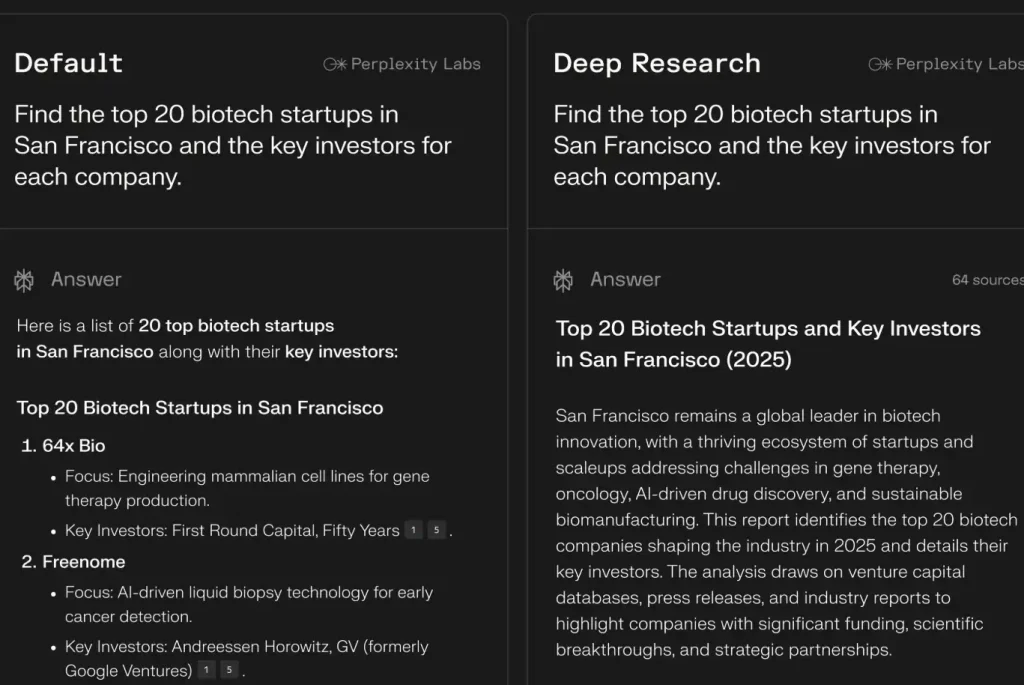
Perplexity describes the Deep Research process as “iteratively searches, reads documents, and reasons about what to do next, refining its research plan as it learns more about the subject areas.” The company says this mimics “how a human might research a new topic.” Examining Perplexity Deep Research capabilities reveals the iterative nature of its design.
Perplexity also highlighted its performance on Humanity’s Last Exam, a benchmark for expert-level AI knowledge. Perplexity’s Deep Research scored 21.1% on the test, outperforming many competitors, but below OpenAI’s Deep Research score of 26.6%.
The most significant differentiator is Perplexity’s pricing. While OpenAI’s Deep Research currently requires a $200-per-month Pro subscription (with plans to expand to other tiers), Perplexity’s Deep Research is available for free. Non-subscribers receive a limited number of daily queries, while paying subscribers gain unlimited access.
Perplexity also emphasizes speed. The company claims Deep Research completes most tasks in under three minutes, compared to OpenAI’s reported 5 to 30-minute timeframe.
This trend reflects a broader shift in the AI market. Precedence Research projects the AI Market size to reach a staggering USD 2,575.16 billion by 2032, and AI’s influence to contribute over $15.7 trillion to the global economy by 2025.
Asked to compare the various deep research products, Perplexity itself offered a concise summary:
- Perplexity AI excels in speed and accessibility for casual researchers
- OpenAI dominates in analytical depth for enterprise applications
- Google integrates most seamlessly with existing productivity ecosystems
While these tools offer significant potential, limitations exist. The Economist recently highlighted shortcomings in “creativity” and a tendency to rely on “easily available” sources, noting that “outsourcing all your research to a supergenius assistant” could “reduce the number of opportunities to have your best ideas.”
Perplexity AI’s Deep Research tool finds substantial utility in product research. The tool’s performance, exemplified by its Humanity’s Last Exam score, is a key asset.
Tags
Read More From AI Buzz

Vector DB Market Shifts: Qdrant, Chroma Challenge Milvus
The vector database market is splitting in two. On one side: enterprise-grade distributed systems built for billion-vector scale. On the other: developer-first tools designed so that spinning up semantic search is as easy as pip install. This month’s data makes clear which side developers are choosing — and the answer should concern anyone who bet […]

Anyscale Ray Adoption Trends Point to a New AI Standard
Ray just hit 49.1 million PyPI downloads in a single month — and it’s growing at 25.6% month-over-month. That’s not the headline. The headline is what that growth rate looks like next to the competition. According to data tracked on the AI-Buzz dashboard , Ray’s adoption velocity is more than double that of Weaviate (+11.4%) […]