
What is OpenAI Grove? A Pre-Idea Founder Program

On September 12, OpenAI announced Grove, a novel five-week mentorship program designed for technical individuals at the “pre-idea” stage of their entrepreneurial journey according to Analytics India Magazine. This move marks a significant departure from traditional startup accelerators by targeting talent before a concrete business concept is formed. Instead of evaluating pitches, OpenAI is investing in people, offering a small cohort unparalleled access to its internal teams and unreleased technology. The OpenAI pre-idea founder program represents a calculated strategy to cultivate the next generation of AI innovators, embedding them deeply within its ecosystem from the earliest possible moment to fortify its long-term dominance in a fiercely competitive landscape.
Key Points
- OpenAI launched Grove, a five-week program for technical individuals before they have a startup idea.
- Participants receive direct mentorship from OpenAI leaders and early access to new models and tools.
- The program functions as a strategic initiative to secure top AI talent and establish platform loyalty from inception.
- Grove enters a competitive market where AI startups attracted 71% of U.S. venture funding in 2025.
Cultivating Minds Before Markets
OpenAI’s Grove is meticulously structured as a talent incubator, not a conventional business accelerator. The program’s design prioritizes deep integration with OpenAI’s team and technology to provide a foundational experience for future AI leaders. For those wondering what is OpenAI Grove program, its core mechanics are built for intensive engagement.
To ensure personalized attention, the inaugural cohort is an intimate group of approximately 15 participants . The five-week intensive, which runs from October 20 to November 21,2025 , employs a hybrid model. It requires mandatory in-person sessions at OpenAI’s San Francisco headquarters during the first and final weeks, with 4-6 hours of asynchronous work each week in between. The application window for the first cohort was brief, with Newsbytes reporting a deadline of September 24 .
The primary benefit for participants is exclusive access, including hands-on experience with new OpenAI tools before general availability and direct mentorship from the company’s technical leaders.
People First, Pitches Second
The most defining characteristic of Grove is its “pre-idea” philosophy. OpenAI explicitly states that Grove “isn’t a traditional startup accelerator program” according to Analytics India Magazine. This approach is a strategic departure from the norm. The distinction between OpenAI Grove vs Y Combinator, for example, is stark: Grove seeks promising individuals, while most accelerators require founders to have a validated idea or early prototype.
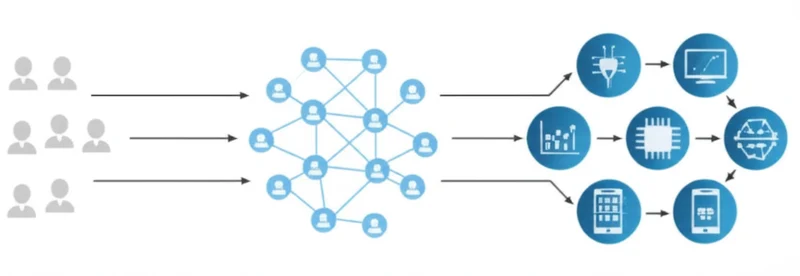
By targeting technical talent before a business plan exists, OpenAI is investing in people, not pitches. This strategy allows the company to influence the foundational thinking of future AI entrepreneurs, encouraging them to build natively on its platform. This early engagement fosters deep-seated platform loyalty and serves as a core component of the OpenAI Grove AI talent strategy, aiming to shape the next wave of innovation from the ground up.
Upstream Talent Capture
Grove complements OpenAI’s existing founder-focused programs, creating a comprehensive talent funnel. It sits upstream from initiatives like the Pioneers Program, which collaborates with companies on specific use cases, and OpenAI for Startups, which helps existing companies scale with API credits and support as detailed by Analytics India Magazine. Grove is the entry point, designed to capture talent at the earliest possible stage.
The program also enters a competitive field. It follows moves from rivals like Google, which launched its for Startups Cloud AI Accelerator last year, and Microsoft, which partnered with PearlX for a pre-seed cohort accelerator. While these programs are formidable, Grove’s pre-idea focus gives OpenAI a unique advantage by engaging talent earlier than its primary competitors, creating a pipeline of innovators already aligned with its technology stack.

The Capital Tsunami Behind AI Talent Wars
The launch of programs like Grove is driven by an enormous surge in venture capital funding for artificial intelligence. According to a J.P. Morgan analysis cited by Newsbytes, AI companies accounted for an astounding 71% of U.S. venture funding in 2025, a sharp increase from 45% the previous year.

In the first half of the year alone, U.S. AI startups raised $104.3 billion. Further data from CB Insights, as highlighted by The Outpost AI , shows that over 1,300 AI startups are now valued at over $100 million. This flood of capital has created an intense war for top-tier AI talent.
In this context, Grove is not just an educational initiative; it is an essential strategic tool for securing a future developer base and ensuring that the most promising new ideas are born on OpenAI’s platform.
Ecosystem Architects: Building Tomorrow’s AI Forest
OpenAI’s Grove program is a forward-thinking initiative that redefines the traditional accelerator model. By focusing on individuals before ideas, OpenAI is making a long-term investment in the human capital that will shape the next era of AI. The program is engineered to cultivate a community of elite builders who are deeply integrated with OpenAI’s technology and vision from their very inception. Upon completion, graduates can seek venture funding or pursue other avenues , and may even explore internal roles , ensuring their talent continues to benefit the ecosystem.
In the high-stakes race for AI platform dominance, will investing in people prove to be the most durable competitive advantage?
Read More From AI Buzz

Vector DB Market Shifts: Qdrant, Chroma Challenge Milvus
The vector database market is splitting in two. On one side: enterprise-grade distributed systems built for billion-vector scale. On the other: developer-first tools designed so that spinning up semantic search is as easy as pip install. This month’s data makes clear which side developers are choosing — and the answer should concern anyone who bet […]

Anyscale Ray Adoption Trends Point to a New AI Standard
Ray just hit 49.1 million PyPI downloads in a single month — and it’s growing at 25.6% month-over-month. That’s not the headline. The headline is what that growth rate looks like next to the competition. According to data tracked on the AI-Buzz dashboard , Ray’s adoption velocity is more than double that of Weaviate (+11.4%) […]