
YouTube's Veo 3 AI Aims to Replace CapCut for Creators

At its “Made on YouTube” event on September 16,2025, YouTube unveiled a significant expansion of its creative toolkit for Shorts, introducing a suite of generative AI features powered by custom Google AI models. The announcement detailed new tools for text-to-video generation, automated editing, and audio remixing, all designed to lower the barrier to entry for video creation. This strategic deployment of Google’s Veo 3 and Lyria 2 models directly integrates advanced AI into the creator workflow, representing a direct challenge to the dominance of third-party editing apps like CapCut and aiming to solidify YouTube’s position in the competitive short-form video market. This deployment of the latest Google AI for YouTube Shorts is a clear signal of the platform’s direction.
Key Points
- YouTube announced new generative AI tools for Shorts powered by custom Google models Veo 3 and Lyria 2.
- The features include text-to-video generation, automated editing, and a “Speech to Song” audio remixing tool.
- Veo 3 Fast, a speed-optimized model, generates 480p video clips with sound from text prompts.
- This strategic move aims to keep creators within YouTube’s ecosystem and directly compete with TikTok and CapCut.
Google’s AI Duo: Veo 3 and Lyria 2 Unveiled
The new features are built on specialized versions of Google’s foundational AI models. At the core of the video generation is Veo 3 Fast, a custom text-to-video model optimized for the rapid iteration needed for Shorts. It generates video clips at a 480p resolution, a deliberate trade-off for reduced latency, as noted by TechCrunch. A notable advancement is that these generated clips can include sound, a crucial element for engagement often missing from earlier tools.
In the coming months, YouTube will roll out more advanced Veo capabilities, including motion transfer, which can apply movement from a source video to a static image. This technology, which TechCrunch reports “captures and transfers movement from one subject to another,” could allow a creator to make a person in a still photo perform a dance from a video. Other features will include applying artistic styles like “pop art or origami” to existing clips and inserting objects into scenes via text prompts, as detailed by NewsBytesApp.
For audio, the “Speech to Song” feature is powered by Google’s Lyria 2 AI music model. This tool transforms spoken dialogue from eligible videos into unique musical tracks, allowing creators to select a specific mood or “vibe” to guide the generation. It is designed to take a “funny phrase, a memorable quote, or a one-of-a-kind sound” and re-imagine it as a musical track, according to a report from TechCrunch.
From Raw Footage to Ready Content
These new YouTube Shorts AI editing tools are designed to streamline the most time-consuming aspects of video production. The “Edit with AI” feature directly addresses the challenge of editing raw footage by automating the creation of a first draft. The system analyzes clips from a user’s camera roll, identifies what it considers the “best moments,” and assembles them into a coherent sequence, complete with appropriate music and transitions.
This feature also includes a generative voice-over that can react to the on-screen action, a capability launching with support for both English and Hindi, a detail that indicates a focus on key global markets. The YouTube Shorts Veo 3 integration is being tested within the main Shorts creation flow and the standalone YouTube Create app.
The initial rollout for the YouTube AI video generator Shorts feature using Veo 3 Fast is for creators in the United States, United Kingdom, Canada, Australia, and New Zealand, per the announcement details. These YouTube Shorts AI editing tools represent a significant step toward an end-to-end, AI-assisted workflow on the platform.
Walled Gardens and Creator Loyalty
This suite of AI tools is a clear strategic maneuver in the ongoing platform wars. The discussion around YouTube AI tools vs CapCut is now more relevant than ever. By integrating powerful generative features directly into its app, YouTube is building a competitive moat to keep creators within its ecosystem, reducing their reliance on third-party editors like CapCut, which has become a dominant force in mobile video editing.
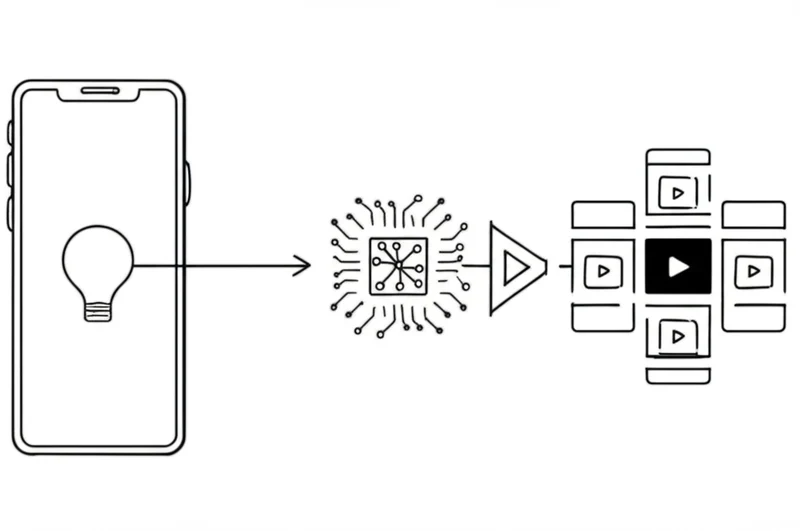
The “Speech to Song” tool is particularly significant, as it provides a native mechanism for engineering the kind of viral audio trends that are the lifeblood of TikTok. As Dina Berrada, YouTube’s Director of Product for Shorts, explained to TechCrunch, it allows a creator to act on an idea and immediately “remix it into a new sound.” This fosters a new layer of remix culture born and cultivated entirely on YouTube, potentially creating a new category of platform-exclusive viral content.
AI Canvas: Redefining Short-Form Creation
YouTube’s integration of Veo 3 and Lyria 2 marks a pivotal moment for the platform’s short-form video strategy. By embedding advanced generative AI directly into the creation process, YouTube is not just simplifying production but fundamentally expanding the creative canvas for millions of users. These tools are engineered to empower a new wave of creators, stimulate novel content formats, and strengthen YouTube’s competitive position. As these features become widely available, their adoption will reveal the new direction of a creator economy increasingly collaborative with artificial intelligence.
How will creators blend their own footage with purely generated content to define the next era of short-form video?
Read More From AI Buzz

Vector DB Market Shifts: Qdrant, Chroma Challenge Milvus
The vector database market is splitting in two. On one side: enterprise-grade distributed systems built for billion-vector scale. On the other: developer-first tools designed so that spinning up semantic search is as easy as pip install. This month’s data makes clear which side developers are choosing — and the answer should concern anyone who bet […]

Anyscale Ray Adoption Trends Point to a New AI Standard
Ray just hit 49.1 million PyPI downloads in a single month — and it’s growing at 25.6% month-over-month. That’s not the headline. The headline is what that growth rate looks like next to the competition. According to data tracked on the AI-Buzz dashboard , Ray’s adoption velocity is more than double that of Weaviate (+11.4%) […]