
AI Plays Quake II? Microsoft Demo Reveals Key Flaws

What happens when AI tries to recreate Quake II just by watching someone play? Microsoft recently released a browser-based Copilot AI Quake II demo to explore this very question. The experiment has generated significant buzz in both gaming and AI communities, showcasing the potential of Microsoft’s Copilot platform for game creation and content generation. While impressive as a technological proof-of-concept, the demo also reveals the current limitations of AI compared to traditional game development approaches, raising fascinating questions about AI’s future role in gaming.
Microsoft’s AI Takes on a Gaming Classic
Microsoft recently turned heads with an unexpected release: a playable Quake II level accessible through any web browser. But this isn’t the original 1997 shooter from id Software. Instead, it’s a technological demonstration showcasing Microsoft Copilot’s AI gaming capabilities in an entirely new light.
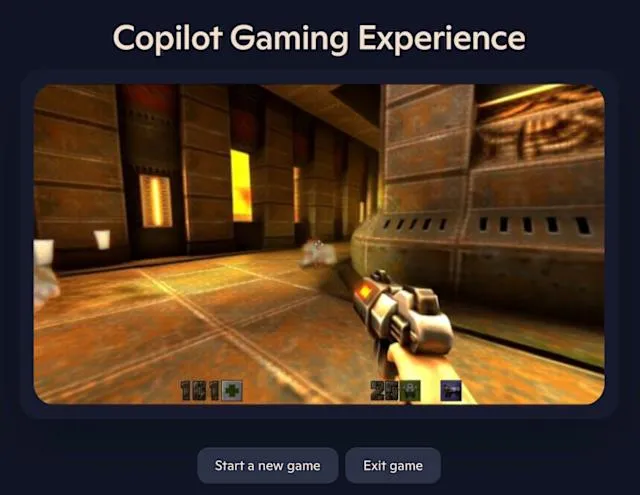
The most remarkable aspect? This version doesn’t run on any traditional game code. Instead, an AI model generates the visuals and attempts to respond to player input in real-time. Microsoft has carefully positioned this as a “research exploration” rather than a finished product – a distinction that became particularly important amid mixed reactions regarding its performance and implications.
Anyone can try the demo for themselves using standard keyboard controls to navigate a single Quake II level before a timer runs out. While the controls feel familiar, you’re not interacting with meticulously programmed game logic – you’re engaging with an AI’s interpretation of that logic, learned entirely through observation.
WHAMM: The Brain Behind the Simulation
Powering this unusual gaming experience is a generative AI model called WHAMM (World and Human Action MaskGIT Model). Part of Microsoft’s Muse family of AI models integrated into the Copilot ecosystem, WHAMM represents a significant step toward interactive AI-powered experiences. Microsoft researchers explained in their detailed blog post that their goal was creating AI capable of real-time world modeling for interactive environments.
The Muse models enable users to “interact with the model through keyboard/controller actions and see the effects of your actions immediately, essentially allowing you to play inside the model.” This marks a fundamental shift in AI applications – moving beyond static content generation toward simulating dynamic, interactive gameplay in real-time.
What’s particularly impressive about WHAMM is its efficient learning process. While an earlier model reportedly needed seven years of gameplay data for similar results, WHAMM learned to simulate Quake II by watching just one week of gameplay footage with corresponding player inputs, according to reports on the research. This dramatic reduction in training requirements demonstrates AI’s rapidly improving ability to learn complex interactions from relatively modest datasets – a crucial advancement for practical applications in game development.
The choice of Quake II was likely influenced by practicality – Microsoft owns the intellectual property through its acquisition of ZeniMax, simplifying legal considerations for a public demonstration.

“Much to our initial delight we were able to play inside the world that the model was simulating,” the researchers noted. “We could wander around, move the camera, jump, crouch, shoot, and even blow-up barrels similar to the original game.” The AI had successfully created a recognizable and interactive version of Quake II based solely on observational learning.
When AI Gets Weird: The Limitations of Playing a Model
Despite this achievement, Microsoft’s researchers were quick to set realistic expectations. They emphasized that users are “playing the model as opposed to playing the game” – a critical distinction that explains the numerous quirks encountered in the demo.
Players using the WHAMM model encountered several limitations that significantly impacted the experience:
- Enemies appeared visually indistinct or “fuzzy,” lacking the clear definition of the original game’s models
- Combat interactions proved unreliable, with damage and health indicators often inaccurate
- Input lag created a noticeable delay between player actions and the AI’s visual response
- Most strikingly, the model struggled with object permanence – elements would disappear or reappear unpredictably if out of the player’s view for just 0.9 seconds or more
These aren’t simple visual glitches but fundamental challenges in AI’s ability to maintain a consistent, logical interactive world based on learned visual patterns. The AI doesn’t truly understand the game’s underlying rules – it’s merely predicting the next visual frame based on previous inputs and frames, leading to breakdowns in coherence.
Interestingly, the researchers suggested these flaws might actually “be a source of fun, whereby you can defeat or spawn enemies by looking at the floor for a second and then looking back up.” They even speculated about possibly “teleporting around the map by looking up at the sky and then back down.” While framed as emergent behavior, these quirks highlight the vast distance between the AI’s current simulation capabilities and the reliable physics and logic of conventional games.

Not everyone found these oddities charming. Writer and game designer Austin Walker shared his frustrating experience via gameplay video, spending most of his limited playtime trapped in a dark room, unable to navigate effectively. Many others, including this article’s author, encountered similar problems: “This also happened to me both times I tried to play the demo, though I’ll admit I’m extremely bad at first-person shooters.” These experiences shifted discussion from theoretical potential to practical concerns about usability.
The Long Evolution: AI’s Journey Through Gaming History
While Microsoft’s demo might seem revolutionary, artificial intelligence has been woven into video games since their earliest days. This historical context helps properly evaluate current AI experiments against decades of AI evolution in gaming.
The journey began with simple reactive behaviors like the opponent paddle in Pong (1972), which merely tracked the ball’s vertical movement – a basic but foundational form of AI. Games like Pac-Man (1980) soon introduced more sophisticated systems, with its iconic ghosts following distinct, pre-programmed algorithms (direct pursuit, ambush, flanking, random movement), each ghost having its own “personality” governing its movement patterns.
The 1990s saw techniques like Finite State Machines (FSMs) become standard, representing a rise of formal AI tools for structured behavior control. FSMs defined character states (like ‘idle’, ‘patrolling’, ‘alert’, ‘attacking’) and rules for transitioning between them, enabling complex behaviors crucial for strategy games and varied enemy encounters.
The push for greater immersion drove further innovation. Bethesda’s The Elder Scrolls IV: Oblivion and Skyrim introduced “Radiant AI” to give NPCs seemingly independent lives with schedules, goals, and reactions to player actions. Creative Assembly’s Alien: Isolation (2014) demonstrated AI’s potential for truly unpredictable gameplay with its adaptive Xenomorph, featuring a sophisticated system that created a dynamic horror experience.
Recent years have seen machine learning bring another paradigm shift – a revolution through integration of ML techniques. Instead of following pre-programmed rules, ML allows AI to learn from data or experience. Racing games like MotoGP use ML for AI drivers that adapt to player actions, while competitive games have seen ML-powered bots defeat top human players in games like Dota 2. Psyonix employed similar techniques to train highly skilled bots for Rocket League using reinforcement learning.
AI has also expanded into content creation through Procedural Content Generation (PCG), using algorithms to automatically create game elements like levels, landscapes, and items. While not always strictly “learning” AI, PCG powers the vast worlds of games like Minecraft and No Man’s Sky, generating diverse environments far larger than could be built manually.
Looking Ahead: AI’s Gaming Future
As AI continues evolving, several promising trends are emerging:
- More believable NPCs with deeper conversational abilities and emotional responses
- Hyper-personalized experiences that adapt to individual play styles
- AI-assisted development tools that help creators build complex worlds more efficiently
- Enhanced accessibility features that adapt games to players with different abilities
- AI companions that learn alongside human players
These advancements come with challenges: balancing sophistication with computational requirements, ensuring AI remains fair and transparent to players, and addressing ethical considerations around personalized experiences.
The Game Continues
AI has evolved from simple arcade opponents to sophisticated systems enhancing nearly every aspect of modern gaming. From creating challenging adversaries to generating vast worlds and personalizing experiences, artificial intelligence continues redefining what’s possible in interactive entertainment.
As game developers and AI researchers collaborate more closely, gaming will likely remain at the forefront of practical AI applications experienced by millions firsthand. The future promises not just more realistic gameplay, but entirely new forms of interaction we’re only beginning to imagine.
Tags
Read More From AI Buzz

Perplexity pplx-embed: SOTA Open-Source Models for RAG
Perplexity AI has released pplx-embed, a new suite of state-of-the-art multilingual embedding models, making a significant contribution to the open-source community and revealing a key aspect of its corporate strategy. This Perplexity pplx-embed open source release, built on the Qwen3 architecture and distributed under a permissive MIT License, provides developers with a powerful new tool […]

New AI Agent Benchmark: LangGraph vs CrewAI for Production
A comprehensive new benchmark analysis of leading AI agent frameworks has crystallized a fundamental challenge for developers: choosing between the rapid development speed ideal for prototyping and the high-consistency output required for production. The data-driven study by Lukasz Grochal evaluates prominent tools like LangGraph, CrewAI, and Microsoft’s new Agent Framework, revealing stark tradeoffs in performance, […]