
Claude Opus 4.6 Agent Teams Automate Enterprise Workflows

Anthropic has launched its most advanced model, Claude Opus 4.6, making it immediately available on Amazon Bedrock. The release marks a significant development in AI-driven software engineering, introducing new agentic capabilities that allow the model to autonomously manage complex, multi-day coding tasks. This launch is supported by top scores on industry benchmarks, which validate its performance against other leading models and signal a shift from AI-assisted coding to more autonomous, AI-driven development workflows within the enterprise.
The integration of Anthropic’s new model with AWS provides developers with a powerful toolset directly within a widely used cloud ecosystem. The introduction of features like “Agent Teams” and a massive context window enables a new class of development tasks to be delegated to AI, fundamentally altering the dynamic between human engineers and their AI counterparts. This release represents a functional expansion of what AI can accomplish in a professional software development environment, based on documented capabilities and performance metrics.
Key Points
- Anthropic has released Claude Opus 4.6 on Amazon Bedrock, introducing advanced autonomous coding capabilities.
- The model achieved a leading 81.42% score on the SWE-bench, demonstrating its real-world engineering effectiveness.
- A new “Agent Teams” feature allows multiple AI agents to collaborate on complex enterprise workflows.
- Market validation includes adoption by eight of the Fortune 10 companies and substantial financial growth for Anthropic.
Digital Minds, Collaborative Design
The technical advancements in Claude Opus 4.6 represent a foundational shift in how AI interacts with large-scale software projects. Two architectural pillars are central to its enhanced capabilities: a massive context window and the introduction of collaborative agentic systems.
The model features a 1 million token context window, currently in beta, which allows it to process and reason over approximately 750,000 words at once. For developers, this means the AI can comprehend an entire complex codebase, leading to more contextually aware and accurate solutions without needing to break problems into smaller, isolated chunks. This capability enables tasks like large-scale refactoring, dependency analysis, and comprehensive bug fixing.

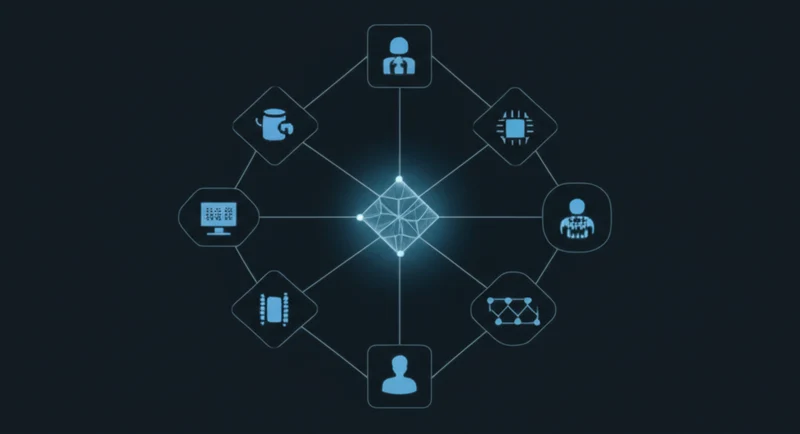
A more groundbreaking feature is the concept of “Agent Teams.” This functionality allows developers to orchestrate multiple AI agents to collaborate on enterprise workflows, effectively mimicking a human development team. This advancement enables autonomous project execution, where different agents handle specialized parts of a task. The model is specifically designed to sustain these agentic tasks for longer periods with greater reliability, allowing senior engineers to delegate complex projects with less oversight than previously required. Understanding AI agent teams is essential to grasping the model’s full potential for enterprise automation.
Performance Metrics That Matter
The technical capabilities of Claude Opus 4.6 are substantiated by empirical data from rigorous, real-world benchmarks and significant market validation. On the SWE-bench, which measures performance on actual software engineering tasks, the model achieved an 81.42% score. It also leads all other frontier models on Terminal-Bench 2.0, a test assessing sustained reasoning and tool use in coding scenarios.
These Claude 4.6 benchmark results extend to general problem-solving, where it reportedly outperforms GPT-5.2 on the GDPval-AA benchmark . This verifiable performance has driven Anthropic’s substantial financial growth and enterprise adoption. The company’s current run-rate revenue is $14 billion , with its specialized Claude Code model contributing over $2.5 billion. This financial success is mirrored in its customer base, with eight of the Fortune 10 companies now using Claude.
The model’s influence is also expanding into education, with initiatives like the “Claude for Education” program at the University of Pittsburgh aiming to make AI more accessible to students. In a notable measure of its industry impact, a recent analysis estimated that 4% of all public commits on GitHub worldwide are now authored by Claude Code.
Cloud Infrastructure Meets AI Intelligence
Anthropic’s deployment strategy is as critical as its model’s architecture. By launching Claude Opus 4.6 on AWS Bedrock, the company gains immediate access to AWS’s vast ecosystem of enterprise customers, simplifying adoption for businesses already invested in the platform.
This integration provides crucial enterprise-grade features, such as a US-only inference option. This capability is essential for organizations with strict data residency requirements and US compliance standards, offering a secure environment for handling sensitive data. This strategic choice addresses a major barrier to AI adoption in regulated industries.

Furthermore, Anthropic maintains a platform-agnostic, multi-cloud strategy. According to industry reports, Claude is currently the only leading AI model available on all three major global cloud platforms: Amazon Web Services Bedrock, Google Cloud Vertex AI, and Microsoft Azure Foundry. This approach maximizes market reach, offers customers flexibility, and positions Claude as a ubiquitous intelligence layer accessible across different cloud environments, preventing vendor lock-in.
Code’s New Collaborative Canvas
The arrival of Claude Opus 4.6 on AWS Bedrock represents a functional shift in the software development lifecycle. The combination of benchmark-validated capabilities, architectural innovations like Agent Teams, and a strategic multi-cloud approach has created a powerful ecosystem for agentic AI. Development cycles that once took days can now be compressed into hours as senior engineers delegate complex implementation tasks. This development, as highlighted in the original article , marks a clear transition toward a new paradigm.
With AI agents now managing entire software projects, the role of the senior engineer is evolving from implementation leader to architectural visionary. How will this transformation reshape the software engineering profession in the coming years?
Read More From AI Buzz

Perplexity pplx-embed: SOTA Open-Source Models for RAG
Perplexity AI has released pplx-embed, a new suite of state-of-the-art multilingual embedding models, making a significant contribution to the open-source community and revealing a key aspect of its corporate strategy. This Perplexity pplx-embed open source release, built on the Qwen3 architecture and distributed under a permissive MIT License, provides developers with a powerful new tool […]

New AI Agent Benchmark: LangGraph vs CrewAI for Production
A comprehensive new benchmark analysis of leading AI agent frameworks has crystallized a fundamental challenge for developers: choosing between the rapid development speed ideal for prototyping and the high-consistency output required for production. The data-driven study by Lukasz Grochal evaluates prominent tools like LangGraph, CrewAI, and Microsoft’s new Agent Framework, revealing stark tradeoffs in performance, […]

Vector DB Market Shifts: Qdrant, Chroma Challenge Milvus
The vector database market is splitting in two. On one side: enterprise-grade distributed systems built for billion-vector scale. On the other: developer-first tools designed so that spinning up semantic search is as easy as pip install. This month’s data makes clear which side developers are choosing — and the answer should concern anyone who bet […]