Microsoft's Magma AI Makes Breakthrough: One Agent Controls Both Software and Robots
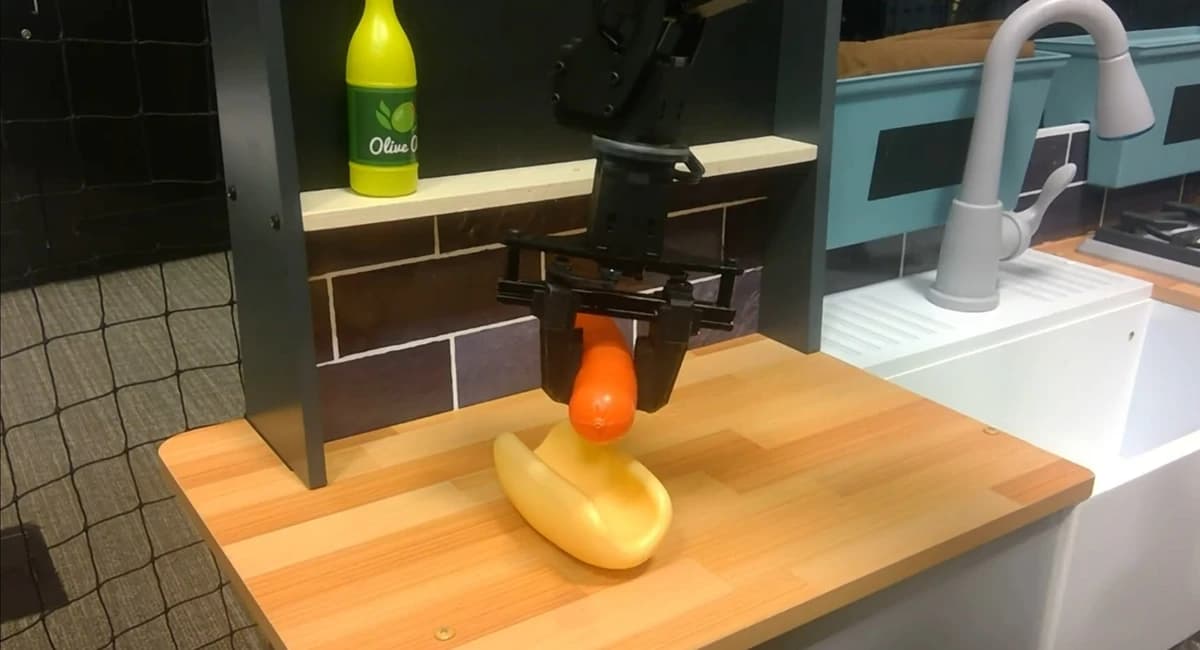
In a groundbreaking development, Microsoft Research has unveiled Magma, a revolutionary AI system that seamlessly combines visual and language processing to control both software interfaces and robotic systems. This innovation could represent a significant leap forward in creating versatile AI agents capable of operating in both digital and physical environments.
Unlike traditional AI models, Magma stands out as the first system to not only process multiple types of data but also act on them directly – whether that’s navigating through software or manipulating objects in the real world. This ambitious project brings together minds from Microsoft, KAIST, the University of Maryland, the University of Wisconsin-Madison, and the University of Washington.
While we’ve seen similar attempts like Google’s PALM-E and RT-2, or Microsoft’s earlier ChatGPT for Robotics, Magma takes a unique approach by integrating perception and control capabilities into a single foundation model.
Breaking New Ground in AI Agency
Microsoft envisions Magma as a stepping stone toward truly agentic AI – systems that can independently plan and execute complex tasks based on human instructions, rather than simply responding to queries. As Microsoft explains in their research: “Magma can formulate plans and execute actions to achieve described goals, effectively bridging verbal, spatial, and temporal intelligence to tackle complex tasks.”
This development aligns with industry-wide moves toward agentic AI, including OpenAI’s Operator for browser-based tasks and Google’s recent explorations with Gemini 2.0.
The Technical Edge
At its core, Magma introduces two key innovations: Set-of-Mark, which identifies interactive elements in an environment, and Trace-of-Mark, which learns movement patterns from video data. These features enable the model to handle everything from clicking through user interfaces to directing robotic arms with precision.
Interestingly, the name “Magma” itself has a story – it stands for “M(ultimodal) Ag(entic) M(odel) at Microsoft (Rese)A(rch),” as clarified by researcher Jianwei Yang in a Hacker News discussion.
Promising Results
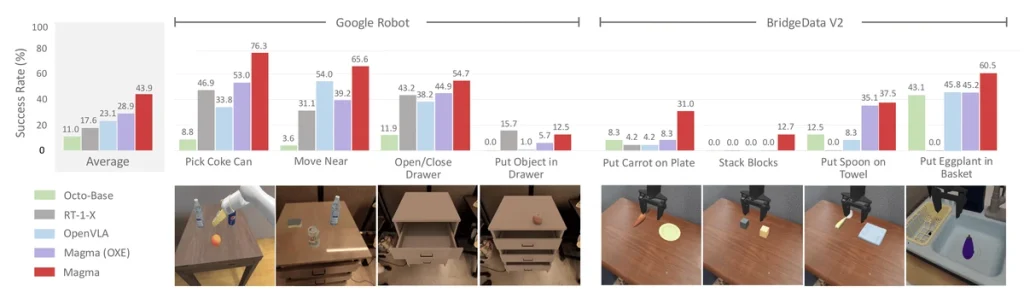
Initial benchmarks paint an impressive picture. Magma-8B has scored 80.0 on the VQAv2 visual question-answering benchmark, surpassing GPT-4V’s 77.2. Its POPE score of 87.4 leads the pack, and it’s showing stronger performance than OpenVLA in robot manipulation tasks.
While these results are promising, they’ll need external verification once Microsoft releases Magma’s code on GitHub next week. The system still faces challenges with complex sequential decision-making, but ongoing research aims to address these limitations.
Perhaps most notably, Magma’s development reflects how quickly AI discourse has evolved. The kind of agentic capabilities that once sparked fears of AI taking over the world have become standard topics in mainstream AI research, no longer triggering calls to pause AI development.
Read More From AI Buzz

Perplexity pplx-embed: SOTA Open-Source Models for RAG
Perplexity AI has released pplx-embed, a new suite of state-of-the-art multilingual embedding models, making a significant contribution to the open-source community and revealing a key aspect of its corporate strategy. This Perplexity pplx-embed open source release, built on the Qwen3 architecture and distributed under a permissive MIT License, provides developers with a powerful new tool […]

New AI Agent Benchmark: LangGraph vs CrewAI for Production
A comprehensive new benchmark analysis of leading AI agent frameworks has crystallized a fundamental challenge for developers: choosing between the rapid development speed ideal for prototyping and the high-consistency output required for production. The data-driven study by Lukasz Grochal evaluates prominent tools like LangGraph, CrewAI, and Microsoft’s new Agent Framework, revealing stark tradeoffs in performance, […]