
MIT's SCIGEN AI Discovers & Synthesizes Quantum Materials

Researchers at the Massachusetts Institute of Technology have developed and validated a new tool that enables generative AI to discover materials with specific, exotic properties, culminating in the successful lab synthesis of two entirely new compounds. The tool, named SCIGEN, functions as a steering mechanism for large-scale AI models, addressing a critical limitation where these systems are biased toward predicting chemically stable but scientifically unremarkable materials. This development, detailed in Nature Materials, marks a significant generative AI for material discovery breakthrough by bridging the gap between computational prediction and physical creation. The successful AI model to lab synthesis validation demonstrates a new, targeted approach for finding next-generation materials essential for quantum computing and advanced electronics.
Key Points
- MIT researchers developed SCIGEN, a tool that injects specific geometric rules into generative AI models.
- The method led to the successful synthesis of two novel compounds, TiPdBi and TiPbSb, validating the AI-to-lab pipeline.
- SCIGEN overcomes the “stability bias” of large AI models, shifting focus to discovering materials with rare quantum properties.
- This approach accelerates the search for materials like quantum spin liquids, critical for fault-tolerant quantum computers.
Breaking the Stability Shackles
Recent advancements in generative AI have produced databases with tens of millions of hypothetical material designs. However, these models, trained on vast quantities of known compounds, exhibit a strong bias toward predicting new materials that are also stable. This “stability bottleneck,” a challenge highlighted by science news outlets , hinders the discovery of materials with rare and exotic properties. As MIT Professor Mingda Li stated, “We don’t need 10 million new materials to change the world.
We just need one really good material” ( MIT News ).
This challenge is particularly acute in the search for quantum spin liquids, where a decade of human-led research has yielded only about a dozen candidates. The latest news on SCIGEN generative AI shows it directly confronts this issue by shifting the paradigm from a brute-force search for stability to a targeted, hypothesis-driven quest for materials with revolutionary traits.

Geometric Rules in Silicon Minds
SCIGEN, or Structural Constraint Integration in GENerative model, enhances existing AI rather than replacing it. It is designed to work with diffusion models, a popular class of generative AI that starts with random noise and progressively refines it into a coherent structure. SCIGEN intervenes at each step of this refinement process.
Scientists can input specific geometric rules, such as requiring atoms to form a Kagome or Archimedean lattice—structures known to host exotic quantum phenomena. At each generative step, SCIGEN checks the AI’s proposed atomic arrangement against these rules, effectively “blocking generations that don’t align with the structural rules,” as noted in the MIT News report. This iterative filtering injects scientific domain knowledge directly into the AI’s creative process. While demonstrated on a model called DiffCSP, the code is designed to be model-agnostic, allowing any diffusion model to follow user-defined structural rules.
Atoms Leap from Algorithm to Reality
The most significant achievement of this research is the tangible proof that the AI discovers new quantum materials that can be physically created. The MIT team and collaborators at Michigan State University and Princeton University executed a full-cycle discovery pipeline. First, the SCIGEN-guided model generated over 10 million candidates with specific Archimedean lattices. After an initial stability screening, a smaller set of 26,000 candidates underwent detailed simulations, with 41% showing magnetic properties.
From this highly curated list, experimentalists successfully synthesized two previously unknown compounds: TiPdBi and TiPbSb. Subsequent lab tests confirmed that the materials’ actual properties closely matched the AI’s predictions. This validation is a powerful demonstration that the MIT SCIGEN AI synthesizes new materials not just in theory, but in a way that leads to real-world results, closing a critical loop in computational materials science—a development that has sparked discussion among AI and science communities.
Quality Over Quantity: The Novelty Gambit
The researchers acknowledge a key trade-off in their approach. By focusing on less common, exotic structures, the overall success rate for generating stable materials is lower. First author Ryotaro Okabe explained, “the ratio of stable materials goes down, but it opens the door to generate a whole bunch of promising materials” (MIT News). This represents a strategic shift from maximizing stability to maximizing the probability of a high-impact discovery.
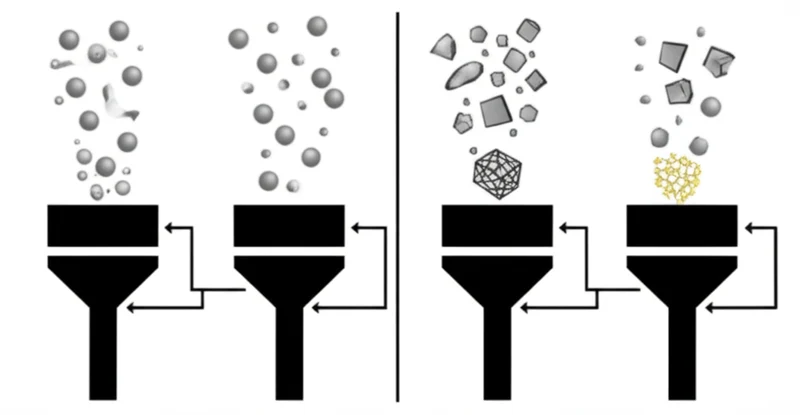
This work also provides a counterpoint to the trend of building ever-larger, generalist AI models. SCIGEN shows the value of specialized tools that augment human expertise, allowing researchers to test complex structural hypotheses at scale. The focus on structures like Kagome lattices is also strategic, as they “can mimic the behavior of rare earth elements,” (Mirage News) offering a path to new technologies without reliance on geopolitically sensitive metals.
Quantum Materials: AI’s Next Frontier
The development and validation of SCIGEN represent a notable advancement in scientific AI. By providing a mechanism to embed human scientific intuition into the generative process, the MIT team has created a powerful tool for targeted discovery. The synthesis of TiPdBi and TiPbSb serves as concrete evidence that this hypothesis-driven approach works. As collaborator Robert Cava of Princeton University noted , this method gives experimentalists “hundreds or thousands more candidates to play with to accelerate quantum computer materials research.” The work has also been praised by independent experts.
Steve May, a professor at Drexel University not involved in the research, stated that the tool ” should speed up the development of previously unexplored materials for applications in next-generation electronic, magnetic, or optical technologies.” As AI tools become more adept at incorporating expert knowledge, which scientific frontier will be the next to see its discovery pipeline so effectively accelerated?
Read More From AI Buzz

Perplexity pplx-embed: SOTA Open-Source Models for RAG
Perplexity AI has released pplx-embed, a new suite of state-of-the-art multilingual embedding models, making a significant contribution to the open-source community and revealing a key aspect of its corporate strategy. This Perplexity pplx-embed open source release, built on the Qwen3 architecture and distributed under a permissive MIT License, provides developers with a powerful new tool […]

New AI Agent Benchmark: LangGraph vs CrewAI for Production
A comprehensive new benchmark analysis of leading AI agent frameworks has crystallized a fundamental challenge for developers: choosing between the rapid development speed ideal for prototyping and the high-consistency output required for production. The data-driven study by Lukasz Grochal evaluates prominent tools like LangGraph, CrewAI, and Microsoft’s new Agent Framework, revealing stark tradeoffs in performance, […]