
NVIDIA Unveils Physical AI, RTX 5090 at CES 2025
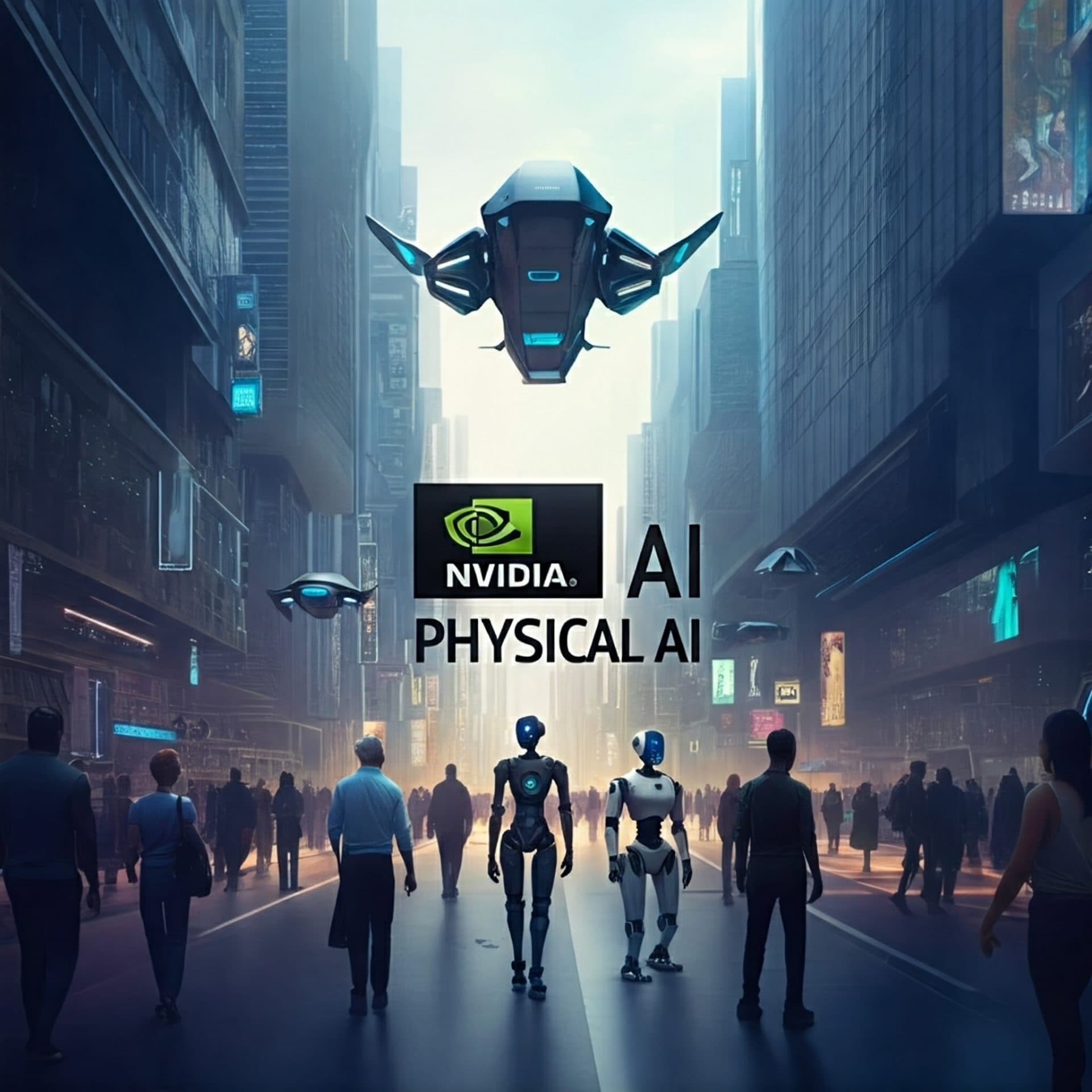
NVIDIA’s Vision for “Physical AI”
NVIDIA’s presence at CES 2025 was a watershed moment in the evolution of AI. Jensen Huang, in his captivating keynote, described a shift from AI that merely perceives and generates content to one that can actively reason, plan, and interact with its physical environment. This new paradigm, which he termed “physical AI,” promises to revolutionize industries ranging from gaming and robotics to autonomous vehicles and industrial automation.
This evolution is made possible by advancements in several areas. First, the sheer processing power of NVIDIA’s new Blackwell architecture, powering the new GeForce RTX 50 Series GPUs, provides the necessary computational muscle. The flagship RTX 5090, with a staggering 92 billion transistors, can execute an incredible 3,352 trillion AI operations per second (TOPS). Secondly, NVIDIA introduced sophisticated new AI models tailored for various applications. These models utilize deep learning and neural networks to achieve remarkable levels of performance.
The Role of Synthetic Data
Another key development is the use of synthetic data for training AI models. NVIDIA’s Cosmos platform demonstrates this innovative approach, generating “virtual world states” to train robots and autonomous vehicles. This addresses the challenge of acquiring sufficient real-world data, particularly in scenarios where it is costly or dangerous to collect.
NVIDIA’s Contributions to the AI Revolution
NVIDIA has cemented its position as a driving force in the AI revolution. Their GPUs and AI supercomputers are the foundation of AI development, and their scalable architecture makes AI accessible to businesses of all sizes. This commitment to democratizing AI also extends to individuals. Integrating its AI stack with Windows PCs through WSL 2, NVIDIA aims to empower users with “world-class AI PCs,” making the power of generative AI widely available.
Key Highlights from CES 2025
- GeForce RTX 50 Series GPUs: These GPUs, powered by the Blackwell architecture, represent a significant leap in graphics and AI processing.
- NVIDIA Cosmos Platform: This platform uses synthetic data to train robots and autonomous vehicles in realistic virtual environments.
- Project DIGITS: NVIDIA’s smallest and most powerful AI supercomputer to date, enabling developers to train and deploy AI models directly from their desks.
Product Availability and Other CES Announcements
The GeForce RTX 50 Series GPUs are highly anticipated by gamers and professionals alike. The RTX 5090 and RTX 5080 will be available on January 30, 2025, priced at $1,999 and $999, respectively. The RTX 5070 Ti and RTX 5070 will follow in February. Laptop versions of these GPUs will be available in March and April, bringing unprecedented AI power to mobile platforms.
During NVIDIA’s showcase at CES, they also discussed their commitment to sustainable AI development. Dion Harris, NVIDIA’s Director of Data Center and HPC, highlighted this in a panel discussion on “The Key to Powering a Sustainable AI Revolution.”
As Jensen Huang, CEO of NVIDIA stated in his keynote address “The pace at which AI is progressing is incredible.” He elaborated that “We are now entering a new era of physical AI, where intelligent systems will not only understand our world but also interact with it in meaningful ways.” This sentiment captures the essence of NVIDIA’s vision for the future of AI.
Beyond NVIDIA, other companies also made significant AI announcements. Samsung and Sony unveiled AI-powered home devices, and the healthcare sector saw a surge in AI solutions for medical imaging, drug discovery, and personalized medicine, as reported by AP News.
According to AI News, “NVIDIA’s advancements in AI are not just incremental; they are transformative.” This underscores the broad impact of NVIDIA’s innovations across diverse industries.
Pivotal moment in AI
NVIDIA’s announcements at CES 2025 mark a pivotal moment in the evolution of artificial intelligence. The concept of “physical AI,” combined with the introduction of powerful new hardware and innovative software platforms, paints a picture of a future where AI is deeply integrated into our lives. This has profound implications for various industries and raises important questions about responsible AI development. As we move forward, NVIDIA’s leadership in driving AI innovation will undoubtedly shape the trajectory of this transformative technology, unlocking new possibilities and challenges alike.
Tags
Read More From AI Buzz
Perplexity pplx-embed: SOTA Open-Source Models for RAG
Perplexity AI has released pplx-embed, a new suite of state-of-the-art multilingual embedding models, making a significant contribution to the open-source community and revealing a key aspect of its corporate strategy. This Perplexity pplx-embed open source release, built on the Qwen3 architecture and distributed under a permissive MIT License, provides developers with a powerful new tool […]

New AI Agent Benchmark: LangGraph vs CrewAI for Production
A comprehensive new benchmark analysis of leading AI agent frameworks has crystallized a fundamental challenge for developers: choosing between the rapid development speed ideal for prototyping and the high-consistency output required for production. The data-driven study by Lukasz Grochal evaluates prominent tools like LangGraph, CrewAI, and Microsoft’s new Agent Framework, revealing stark tradeoffs in performance, […]