
Magenta RealTime: Google's Open Model for Live AI Instruments
Data as of July 6, 2025 - some metrics may have changed since publication

Google DeepMind’s release of Magenta RealTime, powered by the “Atom” model, marks a notable development in generative music technology. Unlike text-to-song services that produce finished audio tracks, this new framework is engineered as a live, interactive musical partner. Its core technical achievement is its extremely low latency, enabling musicians to co-create with an AI in real time using standard MIDI controllers. This development shifts the paradigm from AI as a static generator to a tool for dynamic performance, the latest evolution of AI as a musical instrument. The strategic decision to issue a Magenta RealTime open weights model release further distinguishes it from closed commercial competitors, providing a foundation for community-driven innovation in music technology and placing powerful creative tools directly in the hands of musicians and developers.
Key Points
• Google DeepMind’s Magenta RealTime is powered by “Atom,” a compact Transformer model optimized for low-latency MIDI generation, achieving the sub-20-millisecond response time required for live musical interaction.
• The model functions as a collaborative instrument that integrates directly into musician workflows via the MIDI protocol, augmenting creation in DAWs rather than replacing the artist.
• The release of the model with open weights allows developers to download, modify, and build new applications, contrasting with the closed, API-driven services of competitors like Suno and Udio.
• Documented limitations of current generative models, including Magenta RealTime, show a challenge in maintaining long-term musical structure without human guidance.
When 800M Parameters Meet Real-Time Music
At the heart of Magenta RealTime is “Atom,” a highly optimized, decoder-only Transformer model. This architecture builds on a lineage of models like the Music Transformer that have become the standard for sequence generation, and is specifically designed for the efficient, autoregressive creation of MIDI data. While Atom’s exact architecture is tailored for real-time use, its development aligns with broader Google research into efficient music generation. It functions by predicting the next musical note based on the preceding sequence, making it ideal for a continuously unfolding performance.
The system’s primary innovation is its low-latency performance. For music, true real-time interaction requires latency below the 10-20 millisecond threshold of human perception, a significant technical hurdle for complex generative models. Atom is optimized to achieve this on consumer-grade hardware, a critical detail for widespread adoption.
By building the framework around the MIDI protocol, the industry standard for digital instruments, Magenta RealTime integrates seamlessly into existing musician setups. This includes Digital Audio Workstations (DAWs) like Ableton Live, keyboards, and other controllers, lowering the barrier to entry for professional and amateur musicians alike.
Duet Partners, Not Solo Artists
Magenta RealTime does not directly compete with services like Suno or Udio; it targets an entirely different use case. While text-to-song platforms generate finished audio tracks from a prompt, Magenta RealTime functions as a live accompanist. This approach represents an evolution of Google’s long-standing research into interactive music, building on foundational projects like Performance RNN and the playful Piano Genie, which first demonstrated the potential for responsive MIDI generation.
The distinction is clear in a comparative analysis. Suno and Udio offer low interactivity - a user enters a prompt and waits for a finished song. In contrast, Magenta RealTime offers high interactivity through real-time MIDI control. This positions it as an augmentative tool for performers who can use it as a generative instrument that responds to their playing, creating complex accompaniments that evolve with the performance. As demonstrated in the work of musician and technologist Tero Parviainen, the key to unlocking artistic potential is giving the musician agency and control in a low-latency environment, turning the AI into a true collaborative partner.
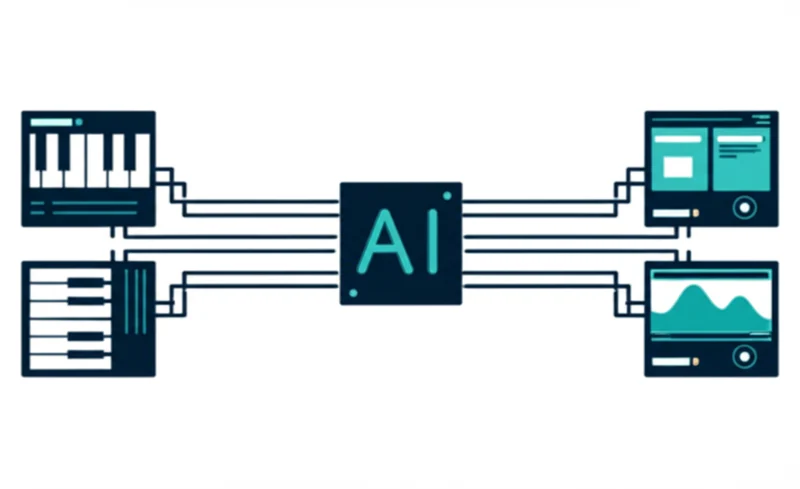
For producers, it serves as an “idea machine” inside the studio, generating melodic and harmonic phrases that can be captured as MIDI for further editing. This workflow is analogous to using generative tools in DAWs, fitting into established creative processes rather than attempting to supplant them.
Democratizing Musical Intelligence
Google DeepMind’s decision to release the Atom model with open weights is as significant as the technology itself. This move democratizes access to a sophisticated AI tool, allowing anyone to download, modify, and build upon the model. Developers can immediately experiment with its capabilities using resources like the official Magenta RT demo Colab.
This open approach fosters a new wave of community-driven innovation, enabling academic research and the creation of novel VST plugins or standalone applications without reliance on a corporate API. It stands in sharp contrast to the “black box” model of most commercial AI music services. As AI observer Simon Willison notes, open models allow for the discovery of new applications by a broader community, not just the original creators. This transparency also allows for community scrutiny, which helps build trust and accelerates progress.
The Improviser’s Technical Boundaries
Despite its advanced capabilities, Magenta RealTime operates within known technical limitations of generative AI. While the model excels at generating harmonically and rhythmically coherent phrases, it can struggle with long-term structural awareness. Building a song with repeating motifs, verses, and choruses still requires human guidance and arrangement.
Furthermore, the technology exists within a complex ethical landscape. The provenance of training data is a major industry concern, highlighted by recent lawsuits from music publishers against AI companies. Magenta has historically used permissively licensed datasets like the Lakh MIDI Dataset, offering a more ethically sound foundation for development. However, a common critique of all AI music tools remains: their use without creative intent can lead to the homogenization of musical styles, producing work that sounds derivative of the vast datasets on which it was trained.
From Algorithms to Artistry
The release of the Google Magenta RealTime collaborative instrument represents a clear shift in the focus of AI music development, arriving at a time of explosive growth in the sector. According to market analysis, the AI music industry is projected to expand significantly, with some reports estimating a multi-billion dollar valuation by 2030. By prioritizing low-latency interactivity and an open-weights distribution model, the technology moves beyond static content generation and places creative agency firmly back in the hands of the musician. This framework provides a foundation for a new class of tools that augment, rather than replace, human artistry.
As developers and musicians begin to build upon this open foundation, the central question becomes clear: what new forms of musical expression will emerge when the artist, not the algorithm, leads the performance?
Weekly AI Intelligence
Which AI companies are developers actually adopting? We track npm and PyPI downloads for 263+ companies. Get the biggest shifts delivered weekly.
About this analysis: Written with AI assistance using AI-Buzz's proprietary database of developer adoption signals. Metrics sourced from npm, PyPI, GitHub, and Hacker News APIs. See our methodology | Report a correction
Data as of March 18, 2026. Data confidence details
Companies in This Article
Explore all companies →Tags
Read More From AI Buzz

Beatoven.ai Delivers a Viable AI Music Model That Pays Artists
AI music startup Beatoven.ai has launched a generative music model built on a fully licensed dataset that compensates artists for each track created using their work. The announcement, as detailed by Analytics India Magazine, introduces a direct revenue-sharing system where musicians who contribute to the training data receive a payment every time their data informs
Spotify vs. YouTube: A Policy Chasm on AI-Generated Music
The viral phenomenon of a band like “The Velvet Sundown” on Spotify, suspected to be entirely AI-generated, is no longer a fringe theory but a documented reality of the digital music landscape. Sophisticated AI tools like Suno and Udio now generate full-length, multi-instrumental songs with coherent vocals from simple text prompts, flooding streaming platforms with

DeepMind AI Solves LIGO Physics Challenge, Boosts Clarity
A collaboration between Google DeepMind and researchers at the Laser Interferometer Gravitational-Wave Observatory (LIGO) represents a significant Google DeepMind LIGO AI breakthrough, successfully addressing a decades-old engineering challenge that limited the sensitivity of gravitational wave detectors. The new AI method, named Deep Loop Shaping, was deployed on the live LIGO system and demonstrated a 30