
Living brief
OpenAI introduces deep researcher agent AI for autonomous discovery
OpenAI launches "deep research," a new AI agent for in-depth research using ChatGPT. This deep researcher agent AI transforms knowledge work as we know it...
Real-time downloads, GitHub activity, and developer adoption signals
Compare OpenAI vs Writesonic→
OpenAI is making waves with the announcement of its latest AI innovation, “deep research,” a new AI “agent” designed to revolutionize the way people conduct in-depth, complex research using ChatGPT, the company’s AI-powered chatbot platform. This tool, appropriately named deep research, is poised to redefine knowledge work, particularly in fields like finance, science, policy, and engineering, where thorough, precise, and reliable research is paramount – acting as a powerful deep researcher agent AI for a variety of applications.

As detailed in a blog post by OpenAI, deep research is built for individuals engaged in intensive knowledge work, especially those looking for autonomous research agent capabilities. It’s not just for professionals, though; the company also suggests its utility for anyone making significant purchases, such as cars, appliances, and furniture, that typically require careful consideration. Essentially, ChatGPT deep research caters to scenarios where a quick answer isn’t enough, and a comprehensive understanding of information from multiple sources is necessary, showcasing its potential for AI-powered literature review.
This new feature represents a significant leap from previous models that focused on rapid responses. Deep research engages in “slow thinking,” dedicating 5 to 30 minutes to analyze a single query. This deliberate approach, as described in an article by Business Standard, allows the system to delve deeper into complex topics, synthesizing information from a wide array of sources, highlighting its use as a semantic search agent. This marks a shift towards what some experts call the “agentic era” of AI, characterized by AI systems that exhibit greater autonomy, adaptability, and task complexity.
OpenAI is rolling out deep research to ChatGPT Pro users, initially limited to 100 queries per month. Support for Plus and Team users is on the horizon, followed by Enterprise users. The query limits for paid users are expected to increase significantly soon. However, the rollout is geo-targeted, with no release timeline yet for users in the U.K., Switzerland, and the European Economic Area.
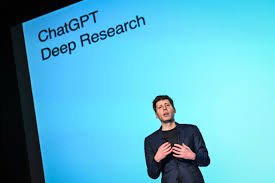
To use deep research, you’ll just select the option in the composer and enter a query. You can also attach files or spreadsheets. The system then takes 5 to 30 minutes to generate a response, notifying you upon completion. While currently text-only, OpenAI plans to add embedded images, data visualizations, and other analytical outputs soon. Future enhancements, as mentioned by Writesonic, will also enable users to interact with research findings in a more intuitive way through data visualization.
The core functionality of deep research involves multi-step research planning, comprehensive source integration, and automated documentation. Deep Research can autonomously break down complex queries into smaller, manageable tasks, executing each step with precision. It can analyze various data formats, including text, images, and PDFs, to provide a holistic understanding of the research topic, meticulously citing all sources. This capability, powered by sophisticated neural networks, allows the system to extract and synthesize information from diverse sources, offering a more complete understanding of the subject matter and potentially generating new hypotheses, as highlighted by an expert from Insight7.
But just how accurate is deep research? AI is known to be prone to hallucinations and other errors. To mitigate this, OpenAI ensures that every deep research output is fully documented, with clear citations and a summary of the AI’s reasoning, making it easy to reference and verify the information. However, Deep Research still struggles with distinguishing authoritative information from rumors, a limitation that users should be aware of.
To enhance accuracy, OpenAI employs a specialized version of its o3 “reasoning” AI model, trained through reinforcement learning on real-world tasks. This version of o3 is optimized for web browsing and data analysis AI, leveraging reasoning to search, interpret, and analyze vast amounts of data on the internet. It can also browse over user-uploaded files, plot graphs using Python, and cite specific sentences or passages from its sources.
OpenAI tested deep research using Humanity’s Last Exam, an evaluation with over 3,000 expert-level questions. The o3 model powering deep research achieved an accuracy of 26.6%, significantly outperforming Gemini Thinking (6.2%), Grok-2 (3.8%), and OpenAI’s own GPT-4o (3.3%). Despite this, OpenAI acknowledges limitations, including occasional mistakes and incorrect inferences.
The introduction of deep research comes at a time of explosive growth in the market for AI-powered research tools. According to Market Research Future, the AI Productivity Tools Market is projected to grow from USD 13.80 billion in 2025 to USD 109.12 billion by 2034. This expansion underscores the increasing demand for AI solutions that enhance productivity and streamline research processes through advanced information retrieval and knowledge discovery.
While deep research offers immense potential, it also raises ethical considerations. Issues such as bias in training data, lack of transparency in algorithmic decision-making, and the potential for misuse are significant challenges, as highlighted by an expert from Alchemy Works. In addition, the premium pricing model may limit access for some users, potentially creating a digital divide, as noted in an article from WalkMe.
Interestingly, Google announced a similar AI feature with the same name not long ago. As AI continues to evolve, tools like deep research will undoubtedly play a crucial role in shaping the future of knowledge work, but careful consideration of their limitations and ethical implications will be essential.
Companies in This Article
Explore all companies →Compare the companies in this article
Weekly AI Intelligence
Which AI companies are developers actually adopting? We track npm and PyPI downloads for 263+ companies. Get the biggest shifts delivered weekly.
Need this brief packaged for a real decision?
If this analysis is directionally useful but not decision-ready yet, request an evidence pack and tell us what question is blocked.
Tags
More living briefs

OpenAI GPT-5-Codex: Autonomous Software Engineering Agent
As reported by The New Stack , OpenAI has officially announced GPT-5-Codex, a specialized version of its next-generation GPT-5 model engineered for autonomous software development tasks. Detailed in an addendum to the main GPT-5 system card, this release marks a significant architectural shift, moving AI from a coding assistant to an agentic partner capable of

Microsoft OpenAI Deal: Equity Stake Replaces Revenue Share
Microsoft and OpenAI are fundamentally reshaping their landmark partnership, pivoting from a structure based on near-term revenue sharing to one centered on long-term equity. According to a report from The Information, cited by The Decoder , a new agreement is being finalized that would grant Microsoft a one-third ownership stake in a restructured OpenAI. In

Microsoft's VS Code Now Defaults to Anthropic's Claude
Microsoft has initiated a significant strategic shift within its developer ecosystem, updating Visual Studio Code to deliberately favor Anthropic’s Claude model for its paid GitHub Copilot service. This move, where Microsoft chooses Anthropic over OpenAI for VS Code, is not a simple partner swap but a calculated decision driven by internal data, where benchmarks revealed