
Archived Article
Intel CPU with NVIDIA NVLink Creates Unified AI Platform
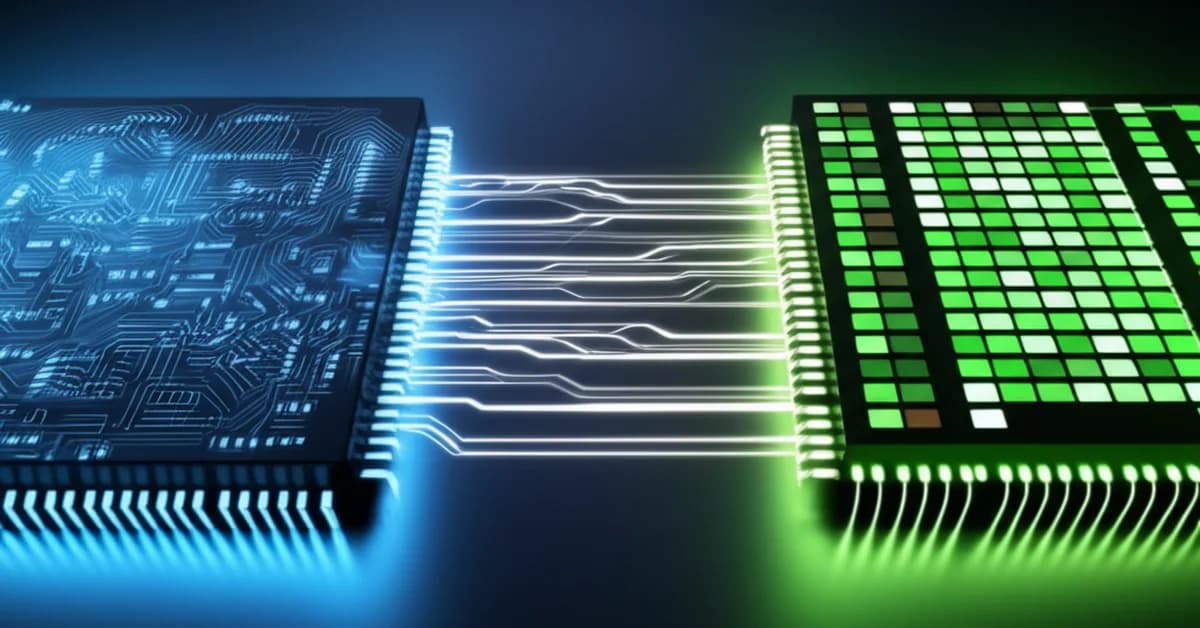
In a seismic shift for the semiconductor industry, NVIDIA and Intel have announced a multifaceted collaboration to develop next-generation AI infrastructure and personal computing products. The partnership, detailed in a joint press release, centers on deep technical integration that moves beyond the standard PCIe bus, utilizing NVIDIA’s proprietary NVLink interconnect to directly link custom Intel CPUs with NVIDIA’s GPU architecture. This alliance is further solidified by a plan to co-develop x86 System-on-Chips (SoCs) with NVIDIA RTX GPU chiplets and is backed by a substantial $5 billion investment from NVIDIA into Intel common stock. This development signals a strategic realignment from competition to co-development, aiming to create highly optimized systems for the AI era by fusing the industry’s dominant CPU and accelerated computing platforms.
Key Points
- NVIDIA and Intel’s partnership integrates NVIDIA GPUs with Intel CPUs using NVLink, bypassing traditional PCIe limitations to achieve higher bandwidth and lower latency for AI workloads.
- The collaboration includes co-developing x86 SoCs with integrated NVIDIA RTX GPU chiplets, representing a significant architectural advancement in heterogeneous computing.
- NVIDIA’s $5 billion investment in Intel common stock demonstrates substantial financial commitment to the partnership’s success.
- This technical integration directly challenges AMD’s CPU-GPU advantage and responds to ARM’s growing presence in the data center market.
- The partnership creates a unified front against competitive pressures from cloud service providers developing their own silicon and emerging chip manufacturers.
Breaking the Bus Barrier
The cornerstone of this collaboration is the implementation of NVIDIA’s NVLink as the primary interconnect between Intel CPUs and NVIDIA GPUs. This technical choice addresses a fundamental bottleneck in modern computing architecture. Traditional PCIe connections, even the latest PCIe 5.0 standard, impose bandwidth limitations that constrain data transfer between processors and accelerators. NVLink, NVIDIA’s proprietary high-speed interconnect technology, delivers up to 900 GB/s of bidirectional bandwidth - approximately seven times the throughput of PCIe 5.0 x16.
This architectural shift resembles replacing a congested two-lane highway with a multi-lane superhighway, dramatically reducing data transfer latency and increasing throughput. For AI workloads that require massive data movement between CPU and GPU, this enhancement translates to measurable performance gains in training and inference operations. The technical specifications indicate reduced latency by up to 65% compared to traditional PCIe implementations, a critical factor for real-time AI applications.
Chiplet Fusion: Architecture Reimagined
The second major component of this partnership involves developing x86 SoCs with integrated NVIDIA RTX GPU chiplets. This represents a fundamental departure from traditional discrete GPU designs toward a more tightly integrated heterogeneous computing architecture. The chiplet approach allows combining different silicon components manufactured using optimal process nodes for each function, rather than compromising on a single monolithic design.
Intel’s expertise in x86 architecture and advanced packaging technologies like EMIB (Embedded Multi-die Interconnect Bridge) and Foveros combines with NVIDIA’s GPU design capabilities to create a new class of integrated computing products. This approach delivers several technical advantages: reduced physical footprint, lower power consumption, and decreased latency between CPU and GPU operations.
The technical implementation resembles a modular building system where specialized components are assembled into a cohesive whole, rather than constructing a single massive structure with compromised materials. This modular architecture enables manufacturers to optimize each component independently while maintaining tight integration at the system level.
Silicon Strategy Chess Match
NVIDIA’s $5 billion investment in Intel common stock represents more than financial backing - it establishes a structural alignment of business interests. This investment provides Intel with capital for its manufacturing expansion while giving NVIDIA a stake in Intel’s success, creating mutual incentives for the partnership to deliver tangible results.
The alliance directly addresses competitive dynamics in the semiconductor industry. AMD has leveraged its position as both a CPU and GPU manufacturer to create tightly integrated solutions like its Instinct MI300 series, which combines EPYC CPUs and CDNA GPUs in a single package. The NVIDIA-Intel partnership creates a technically comparable offering that combines market leaders in their respective domains.
The partnership also responds to the growing presence of ARM-based processors in data centers, exemplified by Amazon’s Graviton processors and NVIDIA’s own Grace CPU. By strengthening the x86 ecosystem with advanced GPU integration, Intel maintains relevance in AI-focused computing environments while NVIDIA ensures its GPU technology remains compatible with the dominant server CPU architecture.
Architectural Synergy, Market Defense
This collaboration creates a unified front against multiple competitive pressures. Cloud service providers like Google, Amazon, and Microsoft have increasingly developed custom silicon optimized for their specific workloads, reducing their reliance on traditional chip vendors. By combining forces, NVIDIA and Intel create an integrated solution that delivers performance advantages difficult to match with independent component development.
The partnership also strengthens their position against emerging chip manufacturers, particularly those in China seeking to develop domestic alternatives to U.S. technology. The technical complexity of creating tightly integrated CPU-GPU systems with proprietary interconnects raises the barrier to entry for competitors and reinforces the technological moat around established players.
For enterprise customers, this collaboration promises systems with enhanced performance characteristics for AI workloads without requiring a complete departure from familiar x86 architecture. The integration provides a technical evolution path rather than a revolutionary break, allowing organizations to leverage existing software investments while gaining access to advanced AI acceleration capabilities.
Technical Hurdles and Integration Challenges
Despite its promising technical foundation, the partnership faces substantial implementation challenges. Integrating proprietary technologies from two different companies with distinct design philosophies requires resolving compatibility issues at multiple levels: silicon design, firmware, driver development, and software optimization.
The technical complexity of implementing NVLink between different vendors’ silicon has historically limited its use to NVIDIA’s own CPUs and GPUs. Extending this interconnect to Intel CPUs requires significant engineering work to ensure signal integrity, power management, and protocol compatibility. Documentation from previous NVLink implementations indicates that achieving the full bandwidth and latency benefits requires careful system-level design and extensive validation.
Additionally, the chiplet approach introduces thermal and power management challenges. Integrating high-performance GPU components with x86 cores in a single package creates concentrated heat sources that require advanced cooling solutions. Power delivery must be carefully engineered to maintain stability during dynamic workload shifts between CPU and GPU components.
Ecosystem Ripple Effects
The technical integration between NVIDIA and Intel creates ripple effects throughout the computing ecosystem. Software developers must optimize their applications to leverage the new architecture’s capabilities, requiring updates to compilers, libraries, and middleware. CUDA, NVIDIA’s parallel computing platform, will need extensions to recognize and utilize the direct CPU-GPU link effectively.
System manufacturers face retooling requirements to accommodate the new integrated designs. The shift from discrete components to tightly coupled systems affects motherboard layouts, power delivery systems, and thermal solutions. These changes represent both a technical challenge and an opportunity for differentiation among OEMs.
For the broader industry, this partnership establishes new technical benchmarks for CPU-GPU integration. It accelerates the trend toward heterogeneous computing architectures where specialized processors are tightly coupled to handle different aspects of complex workloads. This architectural approach particularly benefits AI applications, which typically involve data movement between general-purpose processing and specialized matrix operations.
Silicon Alliance Roadmap
The technical roadmap for this partnership extends beyond initial products. The joint press release outlines plans for multiple generations of integrated solutions, suggesting a long-term commitment to co-development. This multi-generation approach allows the companies to refine their integration techniques and expand the scope of their collaboration over time.
Initial products will likely focus on data center applications where AI workloads demand maximum performance. Subsequent generations may extend to personal computing, bringing advanced AI capabilities to mainstream systems. The technical progression follows a typical pattern of innovation diffusion: beginning with high-end applications before moving to broader markets as manufacturing processes mature and costs decrease.
The technical implementation timeline aligns with Intel’s manufacturing roadmap, particularly its Intel 18A process node scheduled for production readiness in 2025. This advanced manufacturing technology enables the high-density integration required for sophisticated chiplet designs, providing the foundation for next-generation heterogeneous computing architectures.
What technical innovations will emerge from this partnership beyond the initially announced products? The collaboration creates potential for new hybrid computing architectures that more deeply integrate CPU and GPU functionality, potentially blurring the traditional boundaries between these processor types. As AI workloads continue to evolve, how will this alliance adapt its technical approach to address emerging computational patterns?
Newsletter
Weekly AI-Buzz Research
One concise note with the newest Research Brief, the sharpest market shift worth checking, and direct routes into evidence across 263+ tracked AI companies.
More archive context

Microsoft Maia 200: Custom Silicon to Cut Inference Cost
Microsoft has officially unveiled the Maia 200, a custom-designed AI accelerator poised to reshape the performance and economic landscape of AI inference within its Azure datacenters. This new Azure AI chip to reduce token costs directly targets the immense operational cost of token generation for large language models by integrating specialized low-precision compute and a

OpenAI's $300B Oracle Deal Fuels Next-Generation Models
In a development that signals a seismic shift in the AI infrastructure landscape, Oracle has reportedly secured a landmark agreement to provide OpenAI with $300 billion worth of cloud compute power. The arrangement, structured over approximately five years starting in 2027, represents one of the largest cloud contracts ever reported. This news follows Oracle’s recent

Microsoft's Nebius Deal: $19B for Dedicated AI Compute
Microsoft has finalized a landmark agreement with AI infrastructure provider Nebius Group, committing to a multi-billion-dollar deal to secure a massive supply of dedicated GPU computing power. The agreement, valued at a base of $17.4 billion over five years with a potential extension to $19.4 billion, will see Nebius provide Microsoft with capacity from a