
NVIDIA's Hyper Moore's Law, AI Computing Power Doubles Every Six Months
Data as of March 20, 2025 - some metrics may have changed since publication
“Today is the slowest day of change you’ll ever experience.” This statement feels less like hyperbole and more like a sobering reality check as we witness the breathtaking pace of technological transformation around us. We’re living through a convergence of forces - technological, geopolitical, environmental, and societal - that is rapidly reshaping our world in ways we’re still struggling to comprehend.
At the epicenter of this transformation lies artificial intelligence, propelled forward by what NVIDIA CEO Jensen Huang has dubbed Hyper Moore’s Law - a concept that makes traditional technological progress look glacial by comparison.
Beyond Moore’s Law: The New Exponential
While Gordon Moore’s famous law described how transistor density doubled approximately every two years, Hyper Moore’s Law represents something far more dramatic. It’s not just about shrinking transistors anymore - it’s about a comprehensive acceleration across multiple technological domains simultaneously.
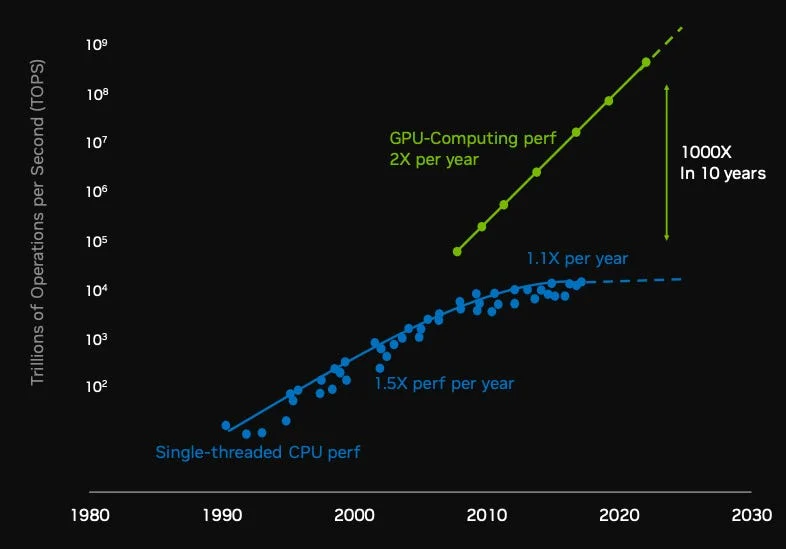
This new paradigm suggests AI computing power is doubling or even tripling annually, driven by revolutionary advances in hardware architecture, software optimization, networking capabilities, and algorithmic breakthroughs. What we’re witnessing isn’t just an evolution of existing technologies - it’s a fundamental reimagining of how technological progress unfolds.
The Perfect Storm of Innovation
The forces behind NVIDIA’s Hyper Moore’s Law come from multiple directions. First, specialized AI hardware like GPUs and TPUs have transformed computational capabilities. NVIDIA’s innovations, particularly in high-speed GPU interconnects like NVLink, have been game-changing.
Simultaneously, software and algorithmic breakthroughs - especially transformer architectures - have revolutionized how AI systems process information. Techniques like transfer learning and federated learning have dramatically improved efficiency.
Perhaps most importantly, the collaborative ecosystem of open-source AI research has accelerated knowledge sharing. Platforms like Hugging Face have democratized access to cutting-edge models and datasets, fueling an unprecedented pace of innovation.
The Cascade Effect: When Innovation Compounds
Today’s AI revolution is powered by unprecedented data availability and the emergence of GPU supercomputers. NVIDIA’s breakthroughs in data-sharing architecture and tightly integrated hardware-software systems have enabled AI to process information at scales once considered impossible.
These capabilities aren’t just incremental improvements - they’re unlocking entirely new possibilities, from generating hyper-realistic content to enabling complex real-time decision-making. Most importantly, these advances are self-reinforcing, creating a cascade effect where each breakthrough accelerates the next.

The Economics of Acceleration
This self-reinforcing cycle is most visible in the economics of AI. Models that once required tens of millions of dollars to train have seen costs plummet by an astonishing 99% in just 18 months. As Alvin Foo highlights in a LinkedIn post, this stunning cost reduction tells the story of technological acceleration in numbers:
- Processing one billion tokens - standard for large language models - now costs $250, down from $36,000 in 2022
- AI compute efficiency doubles every six months according to ComputerWeekly reports, far outpacing traditional Moore’s Law
- Enterprise LLM adoption skyrocketed 400% in 2024 alone
- AI-generated workflows have slashed operational costs by up to 70% across marketing, customer service, and other business functions
These aren’t just statistics - they represent a fundamental shift in who can access and leverage powerful AI capabilities.
The Great Democratization
As the economics of AI shift, so too does its accessibility. Small businesses can now deploy sophisticated AI tools that were previously exclusive to tech giants. Researchers with limited funding can train models that would have been financially impossible just months ago. Governments worldwide are harnessing AI to transform public services.
This democratization isn’t happening in isolation. It’s part of a competitive landscape where innovation comes from unexpected sources. NVIDIA isn’t alone in pushing boundaries - OpenAI is designing custom chips, startups like Groq and Cerebras are reimagining computing architecture, and Asia’s tech sector is rapidly advancing despite challenges. Even in China, companies are developing entirely new chip technologies to overcome U.S. sanctions.
The Shadow Side of Acceleration
Yet this extraordinary progress comes with equally significant challenges. The computational demands driving AI advancement are creating unprecedented energy consumption. As the pace of innovation accelerates, so too must our commitment to addressing these consequences.
These issues aren’t confined to the tech sector - they’re part of a complex web of global challenges that includes climate change, geopolitical tensions, and questions of social equity. The path forward requires addressing these interconnected issues holistically.
Expanding the Boundaries of Possibility
Beyond AI, other technological domains are experiencing similar acceleration. Quantum computing is beginning to tackle problems beyond the reach of traditional computing. Biotechnology is transforming medicine and materials science. Robotics and humanoids are poised to reshape workplaces globally.
These advances bring both promise and peril. Issues ranging from data privacy to ethical AI implementation to misinformation require urgent attention. Perhaps most concerning is the environmental impact - data centers are among the fastest-growing energy consumers worldwide, often powered by non-renewable sources.

The New Cold War
Adding another layer of complexity is the intensifying global competition for technological dominance. Nations are investing heavily in AI and semiconductor development, creating what some have called a digital Cold War, particularly between the United States and China. This arms race is reshaping global supply chains, trade relationships, and geopolitical alliances.
Meanwhile, societal transformations are accelerating in parallel. Urbanization continues even as remote work challenges traditional notions of where and how people live and work. These shifts will fundamentally redefine geographic and economic landscapes.
The Systems Thinking Imperative
The interplay between these forces demands a systems-thinking approach. Progress in one domain cascades into challenges in others, requiring us to adopt a holistic perspective rather than addressing issues in isolation.
Balancing Progress and Responsibility
Never before has technological progress moved so quickly, and never have the stakes been higher. How we navigate these interdependencies will define humanity’s trajectory. We must proactively design systems that balance innovation with sustainability and equity.
The path forward requires embracing complexity rather than seeking simplistic solutions. This moment demands not just technological innovation but a reimagining of our social, economic, and political systems to ensure that progress benefits all of humanity.
Hyper Moore’s Law isn’t just a description of technological acceleration - it’s a symbol of humanity’s ingenuity and a reminder of our responsibility to shape technology’s future thoughtfully. We are living in truly exponential times, where interconnected forces amplify one another in ways we’re still learning to understand.
Charting the Course Ahead
Looking to the future, several key developments will likely shape our technological landscape:
- The Emergence of Artificial General Intelligence: As AI systems grow more capable, the prospect of achieving human-like general intelligence becomes increasingly plausible, with profound implications for society.
- The Transformation of Work: AI-driven automation will fundamentally reshape employment, requiring massive investments in education and retraining.
- The Convergence of Technologies: We’ll likely see accelerating convergence between AI, biotechnology, nanotechnology, and quantum computing, creating entirely new capabilities.
- The Need for Global Cooperation: Addressing both the opportunities and challenges of accelerating technology will require unprecedented international collaboration.
- The Centrality of Human Values: As technology becomes more powerful and pervasive, centering human needs and ethical considerations in design becomes essential.
The future being shaped by Hyper Moore’s Law will be defined by the choices we make today. By investing in research while establishing ethical guidelines, addressing societal impacts, and ensuring equitable access to technology’s benefits, we can harness this acceleration to create a more prosperous and sustainable world for all.
Weekly AI Intelligence
Which AI companies are developers actually adopting? We track npm and PyPI downloads for 263+ companies. Get the biggest shifts delivered weekly.
About this analysis: Written with AI assistance using AI-Buzz's proprietary database of developer adoption signals. Metrics sourced from npm, PyPI, GitHub, and Hacker News APIs. See our methodology | Report a correction
Data as of March 19, 2026. Data confidence details
Companies in This Article
Explore all companies →Make
Workflow automation platform. Formerly Integromat, now with AI features.
Cerebras
38AI compute company with wafer-scale chips
Groq
60Fast inference for LLMs. Hardware-accelerated AI inference platform.
Hugging Face
74Open-source ML platform hosting models, datasets, and Spaces
OpenAI
75AI company behind ChatGPT, GPT models, and the OpenAI API
Tags
Read More From AI Buzz

AI Art Revolution: Create Stunning Masterpieces Without Being an Artist
Want to create stunning, original art in seconds, even if you’ve never picked up a paintbrush? AI art generators are making it possible. With just a few words or an image, you can now generate unique artwork, opening up a whole new world of creative possibilities. This article will show you how. However, it is

Notion AI Agents Revenue Surpasses $500M Amid Agent Launch
Notion has announced a significant evolution of its platform, launching customizable AI agents capable of executing complex, multi-step workflows while simultaneously revealing it has surpassed $500 million in annualized revenue. Unveiled at its “Make with Notion” conference, the dual announcement signals a strategic pivot from a collaborative documentation tool to an intelligent, automated work hub.

ChatGPT's RLHF: AI Alignment via Skinner's Psychology
The sophisticated alignment of large language models like ChatGPT, a process central to their safety and utility, operates on a principle first systematically demonstrated nearly a century ago with pigeons. The technique, Reinforcement Learning from Human Feedback (RLHF), reveals a direct lineage from the psychological “shaping” experiments of B. F. Skinner to the core of